Cleaning House

In Uruguay it is common practice to hire a maid to come clean the house once a week. A good maid, one that cleans well and also won’t steal anything, costs around 500 pesos or about $25US. They will come to your house at the appointed time, maybe even early, and clean for a couple hours. Some maids will only come once a week and will not come if you ask them to come every other week; their reasoning being that it will take too long for them to clean up the mess you’ve made in two weeks as opposed to one.

Raul is a bit protective of his house and requested that we get a maid to come and clean. He prefers she come once a week, but she could come every other week if we really wanted, and she agreed. So we decided we would appease the house owner, which is never a bad thing, and arranged for Moni (the maid) to come and clean. Raul told us she was “100% trust”.

Moni showed up 10 minutes early. This normally wouldn’t be a problem, but we happened to be out buying cell phones and were on plan to arrive just in time to meet her. We didn’t even think she would be early, as lots of things here seem to run on Montevideo time. Luckily Maria, our lovely neighbor in the house, knew her and kept her company until we arrived.

Moni promptly set to work with the kitchen, but not before asking which of us was going to pay her. The maids here will apparently wash dishes and take out the trash. We had been amassing a hefty little collection of empty 6L water bottles that she readily disposed of. Luckily she didn’t toss the two that Matt decided to fill up with water and use as weights. She then came to us with an almost empty bottle of some unlabeled cleaning liquid and said one of two things; that she needed more and she would bring it next time OR that she needed more and we should buy more for her for next time. I guess we’ll find out next time she comes and we’ll just be ready to dash to the store for her.

Other things that Moni did included; mopping all the floors, vacuuming the carpet, sweeping the upstairs, cleaning both of the bathrooms, and sweeping the stairs. I think the vacuum itself was a bit too big to vacuum the stairs so she sprayed the stairs with a water bottle and then swept each stair with a broom. I’m kind of unclear on the role of the water bottle, but she obviously has done it before and it works so I wasn’t about to ask. As she did all this work we tried to stay out of her way. She would come and tell us that she was about to do the upstairs and we would all come downstairs and vice versa.

Moni also asked if we wanted her to take the sheets off our bed to clean and change them. Since we don’t have another set, we said no. Apparently in Montevideo, if you are renting long-term you are expected to bring your own sheets and towels. Luckily Raul left us a set of sheets for each of the beds and said we should get our own at some point. I think we may just make sure that they are clean before we leave.

Maids here may also take things to be washed and brought back the following week. We are missing some of the kitchen rags we were using to dry dishes etc. so we hope they ended up with her!

I must say, she did a great job with the house, although I really didn’t think it was that dirty to begin with. Regardless, Moni will be back next week for more cleaning.


La Lavandería

So, it seems most houses around here don’t have a washer and dryer, and The Little House is no exception. There aren’t places to do your own laundry either. You take your clothes to a lavandería and if you’re organized enough to get them there in the morning, they’ll be done in the evening. I think we’ve seen numerous such establishments in our limited time here, but luckily for our decision making process Raul recommended one that he used.

We (or at least I) seem to assume everything here is going to be hard because we are still learning the language, but as it turns out getting clothes washed is pretty easy. This morning Randi and Kress dropped the clothes off and without too much trouble got a number (11) and were told they would be ready this evening at 7pm. Easy as pie.

Randi and Kress headed off to play Ultimate and I stayed behind for a meeting at work and just as I started making dinner about 8pm realized that I had forgotten. Luckily, we’re in Uruguay and the Lavandería is open until all hours of the night. When I got there with our laundry bags and the ticket our clothes were in fact ready and packed into 6 bags about the size of a pillow each, to ensure that the folding they had done wasn’t lost in transport. Incidentally, their ticket book was on 25 and washers and dryers were still running so there was plenty of action after our clothes were dropped off.

Stacks of clothes

After convincing the husband and wife team that the clothes would in fact fit in the bags (I trusted this was the case since Randi and Kress had transported the clothes this morning in the same bags) they relinquished our laundry and accepted my payment.

It seemed that was the test, after which, we were best friends. The guy behind the counter started asking me a few questions. Apparently, I hadn’t mangled the previous conversation enough to convince him that I was, perhaps, not the best target for conversation. He learned a bit about where I was from, or at least I think I communicated it pretty well. Upon learning I was from the US, he complemented my Spanish. I responded that I was just learning and he said, “Obviously, but it’s much better than my English.” I beamed and ducked out on a high note.

Desfile de Las Llamadas

Translated as the Parade of Calls. This is one of the main events of the carnival season in Montevideo and happens every February. It consists of two nights (last thurs and fri) in which candombe drum groups parade down one of the main streets in Palermo (our neighborhood) from 9 pm until about 3 am. People from all over the city converge on a 10 block area, carrying with them bottles of beer and boxes of wine. The candombe drum tradition originates from an african migrant call to gather, and sometimes uses a complex call and response pattern of drumming.

The Little House is located about 2 blocks from the end of the parade route which means that we were really close when we wanted to go check stuff out, but we were also really close when we just wanted things to be quiet. In the weeks leading up to the parade, various candombe groups would practice their routines by marching through the neighborhood in the evening (usually starting around 10 pm… still haven’t figured out when Uruguyans sleep).

We decided to party it up and went out for chivitos (yummy sandwich of sorts… more on those later) before heading up to see the parade. We got there a little early (i.e. the parade had already started, but the crowds hadn’t arrived) and found a spot right up against the guard rail dividing the street from the sidewalk, and the performers from the spectators. We were at the very end of the parade route which facilitated our arrival and departure.

Some general information about the parade… We were told there were approximately 30 groups walking each night, for a total of about 60-70 groups. The groups with better costumes, prettier girls, and better drumming walk on the second night. Each group is some sort of club, with the better ones having sponsors.

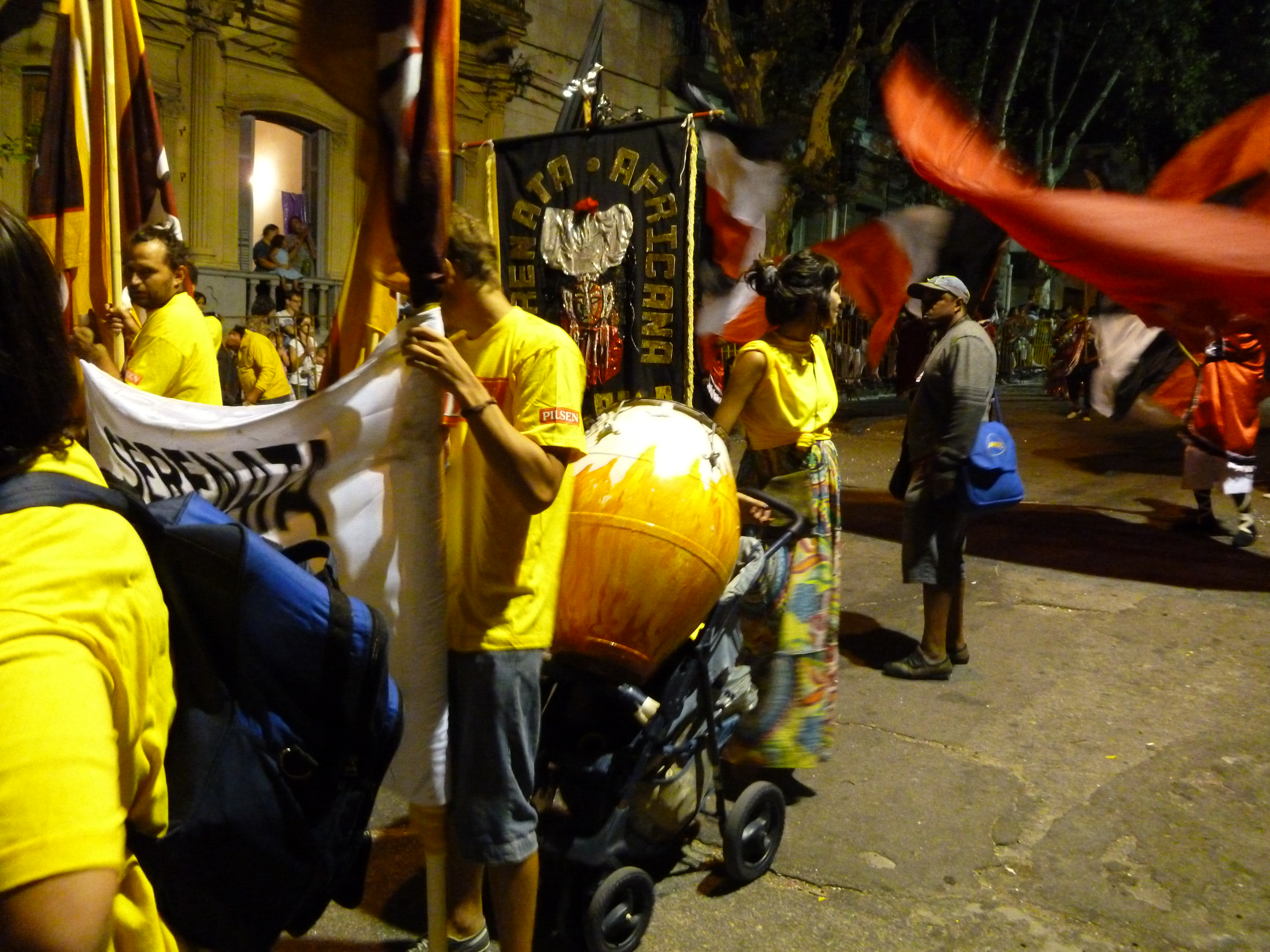
Each group is lead down the street by their banner and a carried coat of arms of sorts. This is followed by various people in costume waving large flags. It seems the thing to do is to fly the flag over the spectators’ heads, allowing them to touch the silky fabric. The children, who inevitably end up in the street with the performers particularly like to play with the flags.

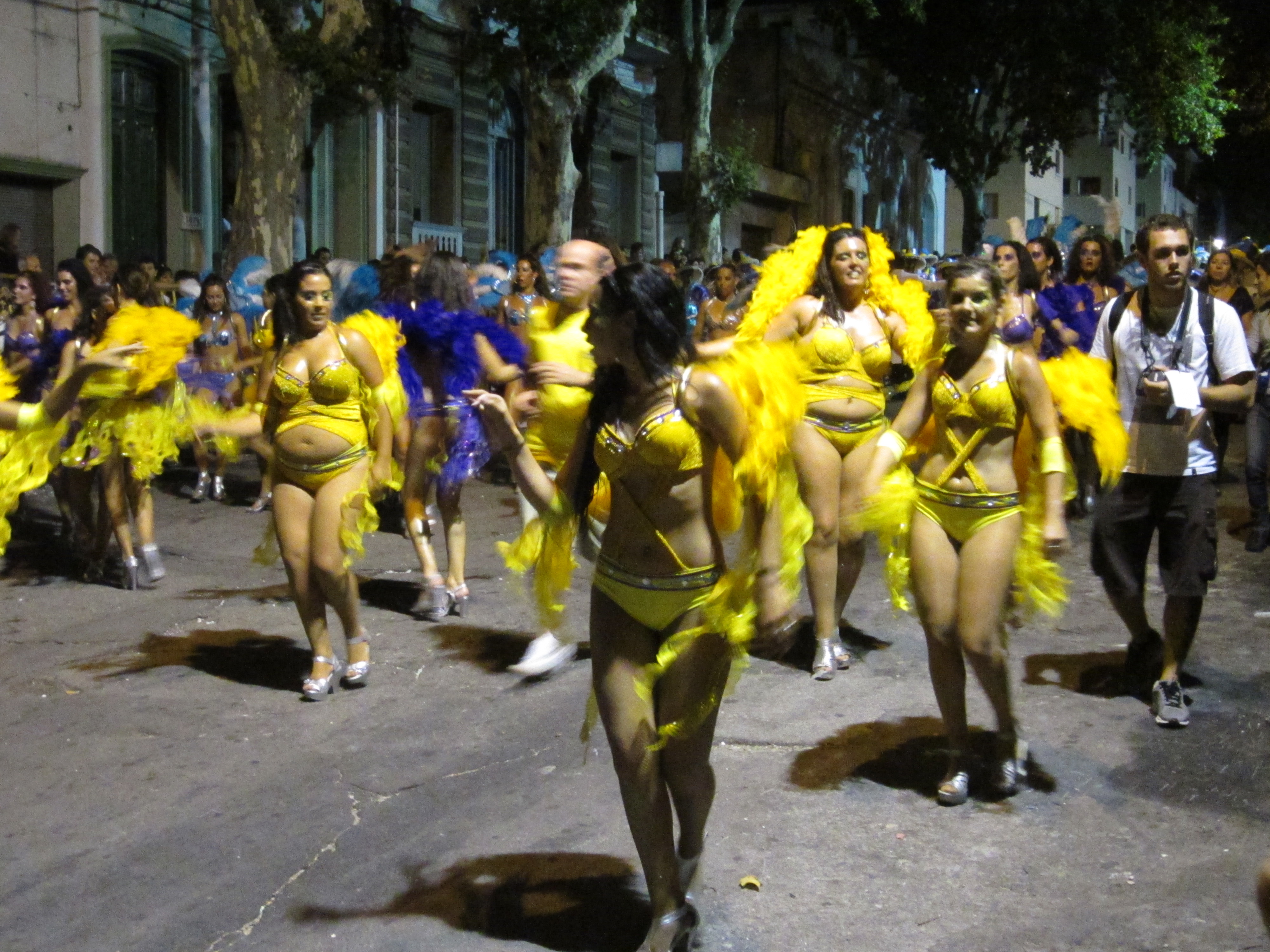
The flags are followed quickly by one or a couple sets of scantily-clad dancers exhibiting various levels of happiness. Having just danced their way down 10 blocks in heels, I understood some of the unhappy faces I saw. If I had to pick two words to describe the dancers I would choose “flashy” and “feathers”. They had feathers in their hair, feathers attached to their shoulders, and sequins everywhere.

Following the dancers were a couple of pairs of old “geezers”; a men and women who are suppose to represent the eldest of the community. The men usually carried canes and wore fake beards and top hats, while the women wore long skirts with petticoats underneath to make them fluff up. All the while they danced and twirled down the street. One group that we saw on thursday night had replaced their old geezer with a young geezer who couldn’t have been more than 4 years old. He still looked the part; sporting a cane, beard and top hat.

Dancing around and through the old geezers and into the candombe drums were two or three girls in more elaborate costumes. Supposedly the prettiest girls in the group were awarded this honor.

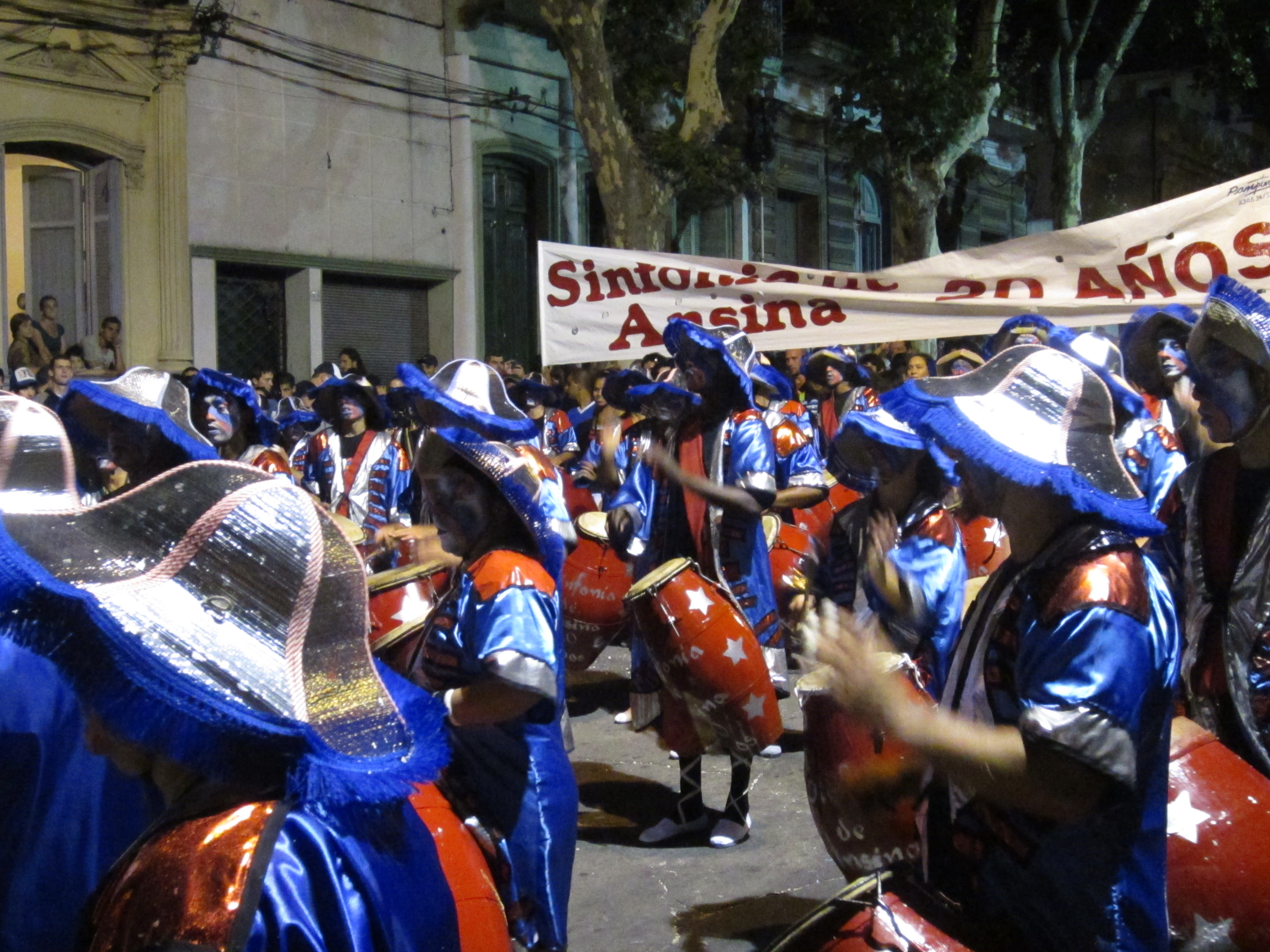
Then came the drums. Deafening, you could hear them coming from blocks away. The sounds from separate groups never  mingled because the one closest was so loud it overshadowed any other sound. The ground vibrated a bit. Each group had 60-80 drummers, almost exclusively men, each playing their own drum painted in the groups’ colors. Not all drums are created equal, as some are larger or smaller and produce deeper or higher pitched sounds. The large drums seem to stick to a 4/4 rhythm while the small ones beat to a different rhythm, maybe a 7/8. It was hard to catch the beat and dance, but it was obvious that was my own unique problem.

Some of the groups would continue playing until they were well off the end of the parade route and on to the next street block. They would be followed by their family and friends and inevitably someone carrying a broken drum.

A broken candombe being pushed along the parade route in a baby stroller.

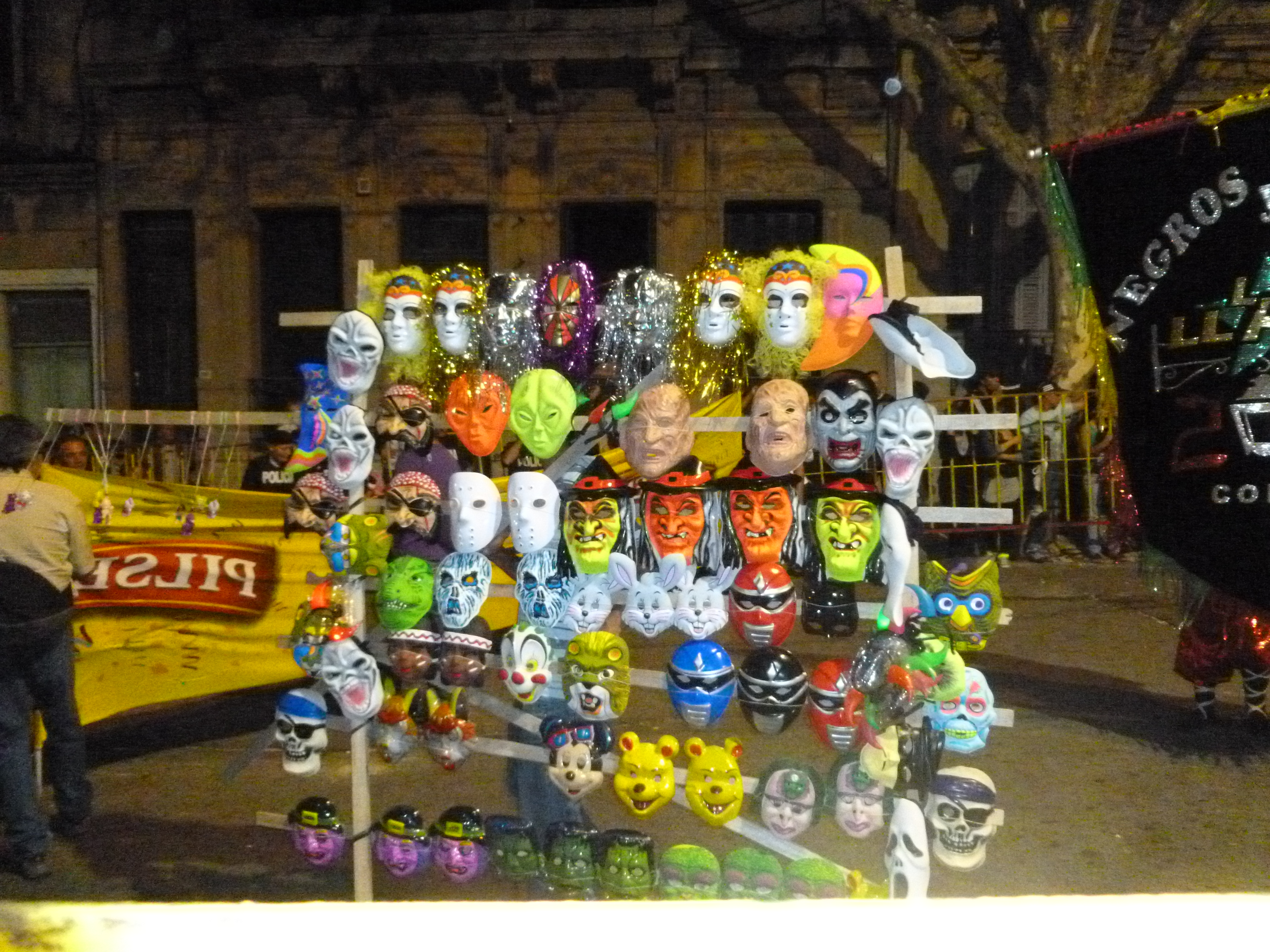
This went on and on, with groups following each other by a few minutes, until the full hours of the morning. Between groups people would come along selling things… carnival masks, light up toys, cotton candy, popcorn, and of course apples on sticks!

For more pictures, see Asa’s Flickr page at http://www.flickr.com/photos/cadburynaught/sets/72157629307021283/

Street Market

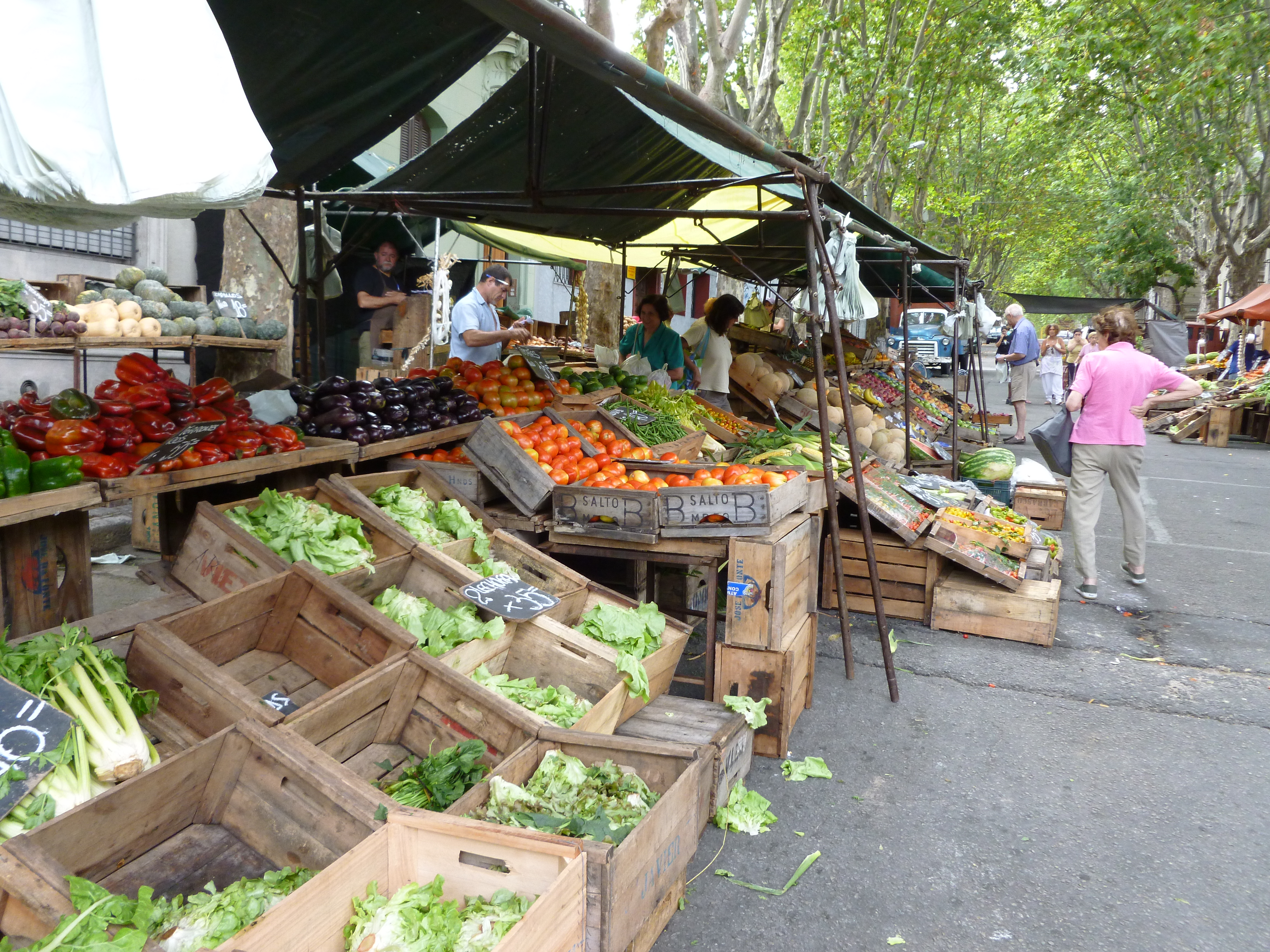
The street markets are definitely where it’s at! They have fresh and yummy tasting produce out the wazoo, and it’s cheaper than the supermarket. There are no barriers closing the street from traffic, but there isn’t really room for cars to pass. Every once in a while a motorcycle rides through slowly and people just get out of the way.

At one end of the market there are people who display wares for sale. For example, today I saw that someone had a pair of jeans to sell, while someone else had some trinkets. I didn’t see anyone actually buying anything and it seems like the people might be set up there on the off chance that someone saw something they just “had to have”. It reminded me of a garage sale, but on a much smaller scale.

The produce stalls make up the majority of the market. All of the stalls seem to have very fresh produce and a much wider variety than in the supermercado. At the majority of produce stalls the sellers will hand you a plastic bag or you grab one yourself and place what you want in it; each type of item in a separate bag. They then weigh the bags; writing each total on a slip of paper to be added at the end. There was one produce stall that stumped us; the biggest one. I guess we just weren’t paying enough attention, but we walked behind the stall to the second row of veggies and grabbed what we wanted. Little did we know, but at this stall everyone is suppose to take a number and then when your number is called you tell the sellers what you want and they put them in plastic bags and weigh them. The seller didn’t seem angry when I handed him the bag with our two bell peppers and said “es todo”. I was prepared to tell him that we didn’t understand and I was sorry, but he didn’t seem to care.

Just one of the many produce stalls!

There were two trucks that opened up to sell goods out of their sides. One was a cheese truck and the other was the local fish truck. We have been told that the fish is very good, but we were a bit too timid to try it today.

The fish man. Maybe next time we'll have the courage to try some of the fish.

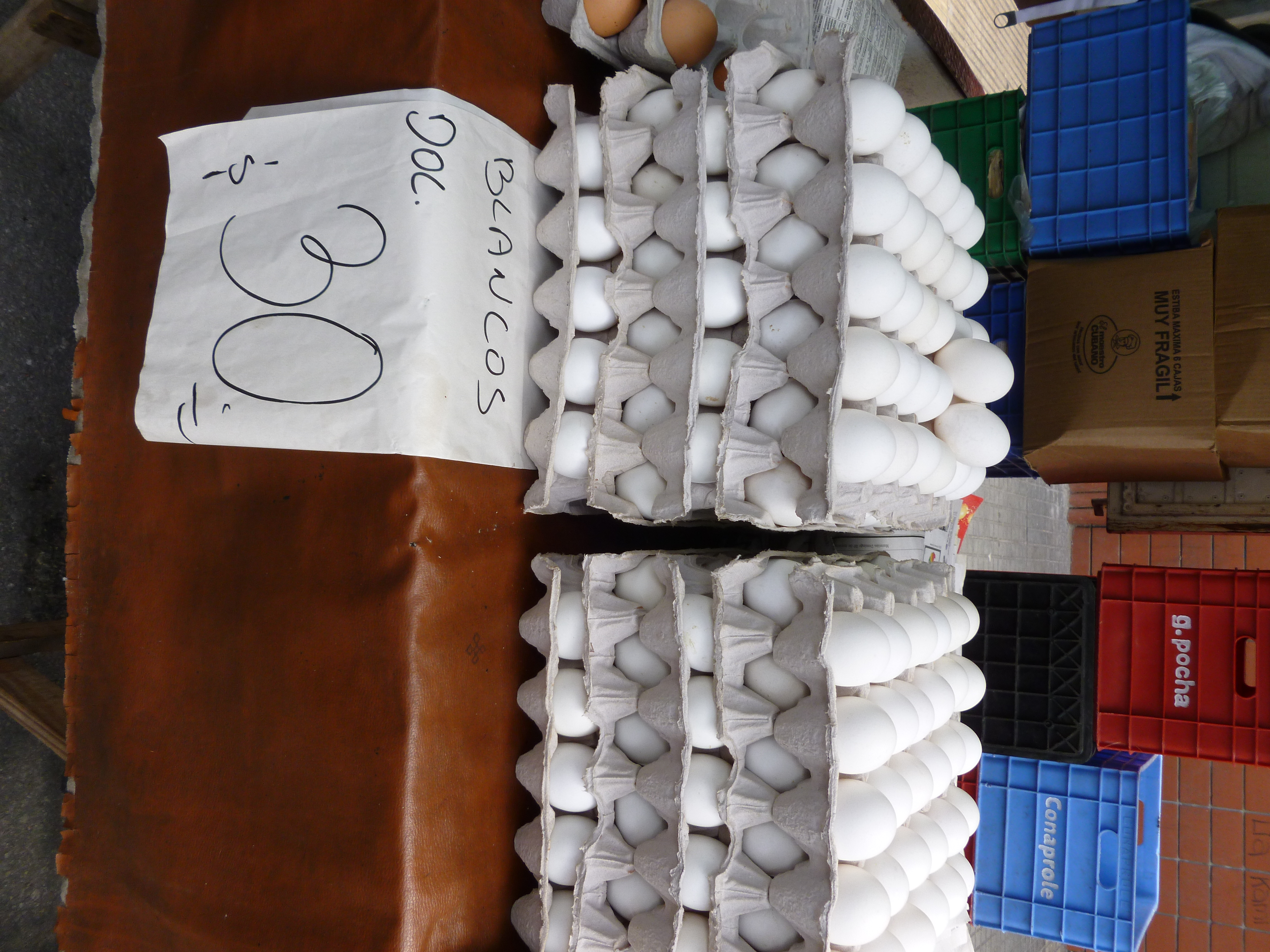
The cheese truck also has an add-on of an egg-man. He sells individual eggs if you want them or in a dozen (“una docena”) and wraps them in newspaper for you to take home.

Eggs for sale! He had both brown and white eggs. We got the brown ones. The brown ones were a bit more expensive, but we figured that must mean that they're better!

All the produce is for sale in kilograms and is remarkably cheap. We got potatoes, garlic, apples, bananas, nectarines, carrots, bell peppers, onions, and eggs for $174 pesos which is about $8US.

Our Spoils!

Getting Around Town: The Bus Edition

Not a lot of people in Montevideo own cars. The majority of people either walk or take the bus to get around town. This results in a couple of things:

1. There aren’t a whole lot of cars on the road. But beware, cars have the right-of-way here unless there is a stoplight or a crosswalk painted with white diagonals. This can be a pain in the butt at a busy street, but jay-walking is a common occurrence.

2. There are a whole lot of people on the bus. There are many stops (“paradas”) and many different routes that take people to all corners of the city and the suburbs. The buses don’t have air conditioning. It would be pointless with all the people and all the stops; the windows just stay open.

We all took our first trip on the bus yesterday to the frisbee fields in town. Luckily we had the help of a new-found ultimate frisbee friend who came to our house to get us. He showed us which bus to take and how to actually do it. We were all a little worried, as we had seen tons of buses but couldn’t figure out how one would actually pay to ride. The bus costs $19 pesos, about $1US, for each ride. You can purchase a more expensive 2 hour ticket if you want, which allows you to ride as many different buses for that amount of time, but I think that’s still a bit advanced for us.

Our friend showed us where the nearest bus stop was to our house and which bus to take. In every bus there is a driver and a ticket seller. The ticket seller sits on one side of the bus and will take your money and give you a ticket in exchange. He will also give you change if you need it. After you have gotten your ticket you either find a seat (rare during peak hours), or you hoof it as far back as you can in the bus and try not to fall over.

We got to see a lot of the city during the hour long ride to the fields. Not all rides take this long, but the fields that the City of Montevideo has given the ultimate team to play on are in the suburbs. We are told that there’s not a shorter way to get to the fields unless you want to pay for a taxi. Ah well, sometimes time seems to have a different meaning here anyway.

Preparing to Live in Uruguay

Getting rid of your stuff is hard.

It takes a lot more time to go pretty close to minimalist than you might think. Once I made the decision to move and started to learn more about mnimalism, I had four main realizations:

  1. I had a lot of stuff (just look at about half of the books I own above)
  2. I had to get rid of 90% of it
  3. I didn’t want to get rid of it
  4.  I had to fit it all in 2 suitcases and 1 backpack

Having way more stuff than needed

At a quick glance, I had: three closets worth of clothes, sports equipment, multiple computers, monitors, a ton of books, random trinkets, and more “stuff” that just took up space. A few girls were even jealous that I had three closets of clothes. What can I say? I liked them.

There was no way I was going to bring even half of it with me. I had to sell, donate, or trash a bunch of stuff so I decided to learn minimalism.

It was quite easy to make the decision to go minimalist, but it was a lot harder to figure out what to get rid of and what to keep. My biggest struggles were figuring out what clothes I was going to bring.

I had to bring enough clothes for:

  • Ultimate Frisbee
  • Summer
  • Winter
  • The beach (ultimate clothes)
  • Learning to dance (business casual)
  • Networking (business casual?)

Minimalism doesn’t mean bringing it all.

As much as I wanted to bring a shipping container down with me, I needed to maximize the use of every item in my wardrobe. Asa wrote a post about his preparation and how he tries to maximize his wardrobe here.

I’m not a hoarder by any means, but I liked the stuff that I had. I wanted to keep everything!

Just in Case

Luckily, as I was trying to figure out what to bring, a good friend told me that Joshua and Ryan from The Minimalists were touring around and having a meetup in Atlanta. I checked out their site and really liked the essays that I read so I decided to check it out with him and some friends.

Over drinks and dinner, the group talked about different ways to pair down items, what they have learned, and various questions asked by people there.

I asked them about what to do about bringing just in case items. Just in case items are things like bringing a suit just in case I can network and possibly do some work for companies down here. They basically said that whatever just in case items I might need, I could find withing 20 minutes for $20. You can read their excellent post about it here.

Make it a Game

I decided I needed to start making decisions and deciding what to bring and what not to bring. I turned it into a game to try and only own 50 items including laptop, video and point-and-shoot camera, and Ultimate Frisbee stuff. I knew I wouldn’t make it that low, but I aimed for it.

I love playing games, so it helped me get rid of stuff.

I wanted to fit everything I owned in only a backpack and 2 suitcases. In order to replace a few things at once, I started buying more things that would replace 2 or more items. For example, I bought a patagonia backpack to replace my Ultimate Frisbee bag and computer backpack. This saved a bunch of room. I bought a pair of Patagonia Maui Air loafers to replace a few different pairs of shoes that I wanted to bring. It also doesn’t hurt that they are the most comfortable shoes I’ve owned.

After all the time spent getting rid of the car, truck, sports gear, and clothes, I actually had a little extra room in my suitcase.

Giving Away More

I was able to bring a bunch of Spin Ultimate gear thanks to the amazing people at Spin for Asa, Randi, and myself to give away to people down here who might not have jerseys or to include in tournament prizes as long as we take pictures of the stuff and people wearing it. I weighed my bags, had to move a few things around to get both bags under 50 lbs, and was good to go.

A Helping Hand

I’m extremely thankful of my roommate, friends, and family for helping me get rid of stuff and deal with a few more items that I left behind and didn’t get rid of. As my usual self, I waited until pretty close to the last minute and had a lot more stuff than I initially thought.

Looking at what I have now, I would be comfortable in any scenario and feel like the shackles have been removed from me by getting rid of stuff.

It’s a pretty awesome feeling!

If you ever feel like you have too much or you keep acquiring stuff, I recommend spending an hour or two and cleaning out your closet or a room in your house. Aim to donate or sell one giant trash bag worth of clothes or items that are sitting around. It’s a freeing experience!

La Playa (i.e. the beach)

Our first visit to the beach was this weekend. People seem to flock to the beach on the weekends as early as 8:30 am. Most people just sit in chairs to sunbathe, but some wade in the water or play with a ball. We are a little dubious about the water quality, but are told the government says its safe to swim. The people we know here say they wouldn’t swim in it.

The beach has sand volleyball courts, tons of trash cans, porta-potties, and its’ very own ice cream man that yells “helados!” all day long. There are also a series of large poles, evenly spaced. They were obviously put there so that we could do beach workouts for ultimate. Right?

The beach looking back towards the neighborhood we live in.

View of the beach looking away from our neighborhood. I think all the flags are up for Carnival in 2 weeks. These are also a couple of the large evenly spaced poles I mentioned.

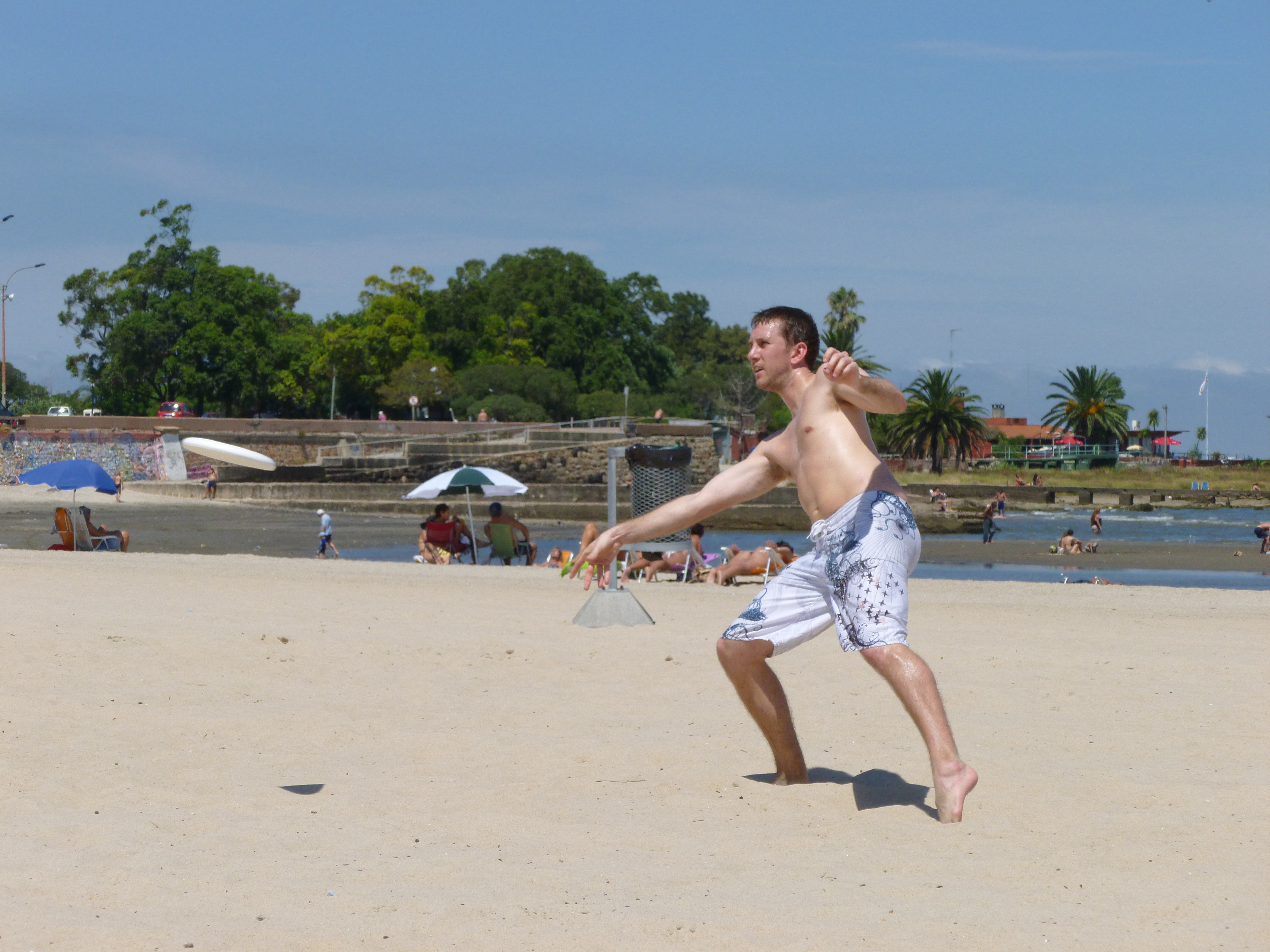
What did we do at the beach? What else would we do… We threw a frisbee. I think this more than anything else pegged us as tourists. That and the fact that we’re all so white. Step 1: Learn spanish. Step 2: get a tan.

Matt throwing a frisbee on the beach.

The Little House

Yep, that’s what Raul calls it… “The Little House”. When we finally made it to The Little House Raul had about 2 hours of instructions for us on how to take care of, and live in his house. He seems very nervous about renting his house out for the first time. Quite understandable. We assured him that we would take good care of his property. During our orientation he took us room by room telling us all about what we needed to do. Here is a brief recounting…

Entryway: There are two keys that were given to us for the two doors. There is a door that opens to the street and another door into the apartment. Between the two doors there is an atrium of sorts with a stairway up to the roof and some plants and such. Raul told us to be respectful of the space between the doors and to be quiet.

Looking out the window into the entryway. The doorway you see leads to the street and the stairs lead to the rooftop.

Living room: The living room has a cool tile floor, a couch, a chair, and a coffee table. There is also a TV with DVD player and cable which we’ll probably never use. There is also a stereo which Asa has promptly set up with our airport so we can play music through it from our computers. There is also a fire place which we’ll definitely never use, as its way too hot. Raul also directed our attention to an antique drum, a “candombe” drum, which is a traditional Uruguayan drum used during carnival. He told us under no circumstances, especially when we were drunk, were we allowed to play the drum.

The living room from the front door.

Atrium: The atrium is a great little place open to the sky and contains numerous plants. Raul gave us specific instructions on how to water the plants. This might be my biggest concern about The Little House. Asa and I have been known to kill bamboo (of course we didn’t tell Raul this). We’ll do our best. There is a beautiful table and set of chairs to use in the atrium but need to be brought in from the rain. Thus far, every day we’ve been here has had a chance of rain greater than 50%, but we’ve only seen a couple of drops. Guess we’ll figure out when it’s actually going to rain once we’re more familiar with the weather patterns.

Table and chairs out in the atrium.

View of the atrium from an upstairs bedroom window.

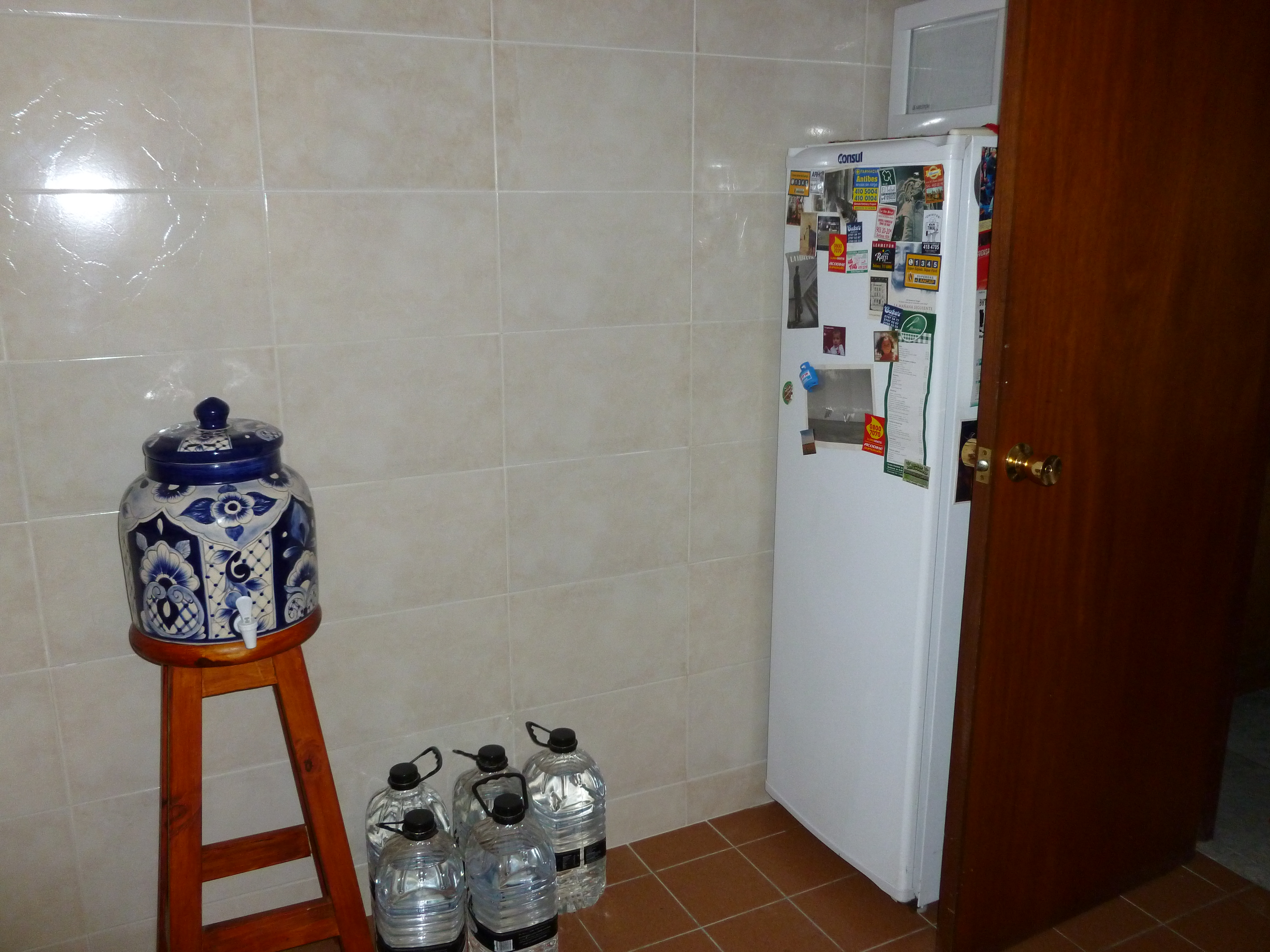
Kitchen: It’s tiny. There is a new, small gas stove with burners, a sink, minimal counter space, a small fridge, a microwave, a toaster, and a hot water pot. The Little House  and its water tank are almost 100 years old, so Raul recommended not drinking the tap water and instead buying bottled water. There is a large ceramic jug with a spout on a stool for this purpose. Raul also has a collection of glasses and has requested we use the ones that are not part of any sets, that way its not so bad if we break them.

The kitchen featuring the new little gas stove and the door into the atrium.

Yes, this is all the counter space we have!

The water jug and our half-size fridge.

Bathrooms: There is a full bathroom upstairs and a half bath downstairs. Both toilets have a holding tank and flush on the wall above. It takes forever for the tank to refill after its been flushed. We’ve also been warned not to put too much paper down the toilet. What “too much” is, is a mystery I hope we never solve.

This is the upstairs toilet and shower. Yes, that is yet another live plant we'll try to keep alive!

Bedrooms: There are three small bedrooms upstairs. A somewhat larger bedroom has a queen bed and a somewhat smaller bedroom has a twin bed. Both beds have a mosquito net hanging from the ceiling, although we’ve only seen a couple of mosquitos. We keep the windows open all day and night so the house can “breathe”, so the mosquito nets can’t hurt. Both of these bedrooms have windows that open to the atrium. The third bedroom is an office with a desk. Its’ windows open into the entryway and it’s darker than the other two rooms for most of the day.

The master bedroom.

This is the office.

Rooftop: In the entryway there are stairs leading up to the communal rooftop (there are two other apartments in the house). The stairs have a locked gate at the top so that no one can get into the house from above. On the roof there is a table and chairs, a place to hang a hammock, and a space to grill. The grill is old-fashioned and necessitates building a fire and placing meat over the flame. There’s not much of a view from the roof, as all the buildings are about the same height and the streets are lined with trees.

The rooftop. The gate on the left leads down the stairs into the entryway.

All in all… It’s a pretty awesome little house.

A taste of Lemanjá

We took a quick trip to the beach to see what Raul had told us was a must sea event. He mentioned something about candles and that it was just up the Rambla on the beach. We later found out it was a festival for people to provide offerings for the water goddess, Lemanjá. So, around 10:30 or so we set out.

As soon as we made it past the American Embassy, we could see that there were throngs of people hanging out near the beach. We walked up to the beach and it mostly seemed like aftermath of small boats washing ashore and hundreds of holes with lit candles inside. It was quite scenic and we were pretty happy with just that. Still we were disappointed that we had missed out on the festival. About the time we gave up hope, a group of people dressed in all white carrying a boat passed by us headed for the beach. As it turns out, the event isn’t over at all, groups pay tribute all night long.

The beach littered with candle divits and throngs of people

Generally, groups where about 20 people all dressed in white, some with tiki torches, some with candles and 6 or so people carrying a small boat (not because it’s heavy but because it’s a ritual). In front of the group, is someone ringing bells that sound something like sleigh bells. This group heads down the stairs to the beach and after some preparation (we were too far away to see what exactly) they lit the candles/tiki torches on the shore (sometimes there was even a candle on the boat) and waded out into the water about 500 yards to send the offerings out to sea. The wind was blowing out to sea, so the boats that had candles and sails provided an impressive display as you could see them far out into the sea.

Raul was right, this was a pretty impressive spectacle. I’m glad we decided to follow his suggestion and head out to observe.

Planes, Trains, and Automobiles: Our Journey to Monetvideo

The day started off exactly as planned; with the alarm ringing at 5:15 AM. All of us, grandma included, piled into the prius with all our stuff and drove to the train station where we took the obligatory picture of us with all our stuff. I’m sure it’ll make the holiday card next year.

The "before" picture

The train was on time, as it should be at the start of the route, but is hardly ever true for the rest of the stops. We said our goodbyes and waved and blew kisses (well I did) from the train window and we were off. After collapsing into an early morning nap for about an hour, we woke up to the ocean and dolphins. The Pacific Surfliner is definitely best when experienced from the west side of the train, as it hugs the coastline between Lompoc and Oxnard. The train ride was uneventful just as we had hoped and we even arrived at Union Station in Los Angeles on time. We managed to find the baggage claim. “Past the Subway sign” the Amtrak worker told us. We were really confused until we saw the sandwich shop.

This brought us to the part where I (along with many others) broke Asa’s bag (see his previous post). The baggage claim at Union Station happens to be at one end of the station and the FlyAway Bus (to LAX) at the other. The Station isn’t big but has a very European feel to it and it was big enough for us to just miss the FlyAway bus. Luckily they run every 30 min. Neat, efficient, and cheap (only $7) system they have. Would recommend it to anyone traveling from Union Station to LAX. Out of curiosity, we estimated their profit before overhead to be somewhere in the ballpark of $7000 a day just for their Union Station location.

We made it to LAX after an uneventful ride on the FlyAway bus. We found our way to the departures and the hotel shuttles. Hotels in the LAX area have banded together in an effort to reduce pollution and now shuttles service multiple hotels. Super idea! We found ourselves at the hotel and checked into our room by 2 PM. We grabbed some food and went to find Asa a new suitcase. Fun!

The next day, Jan 31 was our big travel day. LAX to Miami to Montevideo and about 18 hours of travel time. I think we set a new record that morning by making it from our hotel room to our gate at the airport in under 30 min. We had planned on giving ourselves some time in case it was busy, so we ended up sitting at the gate for a long time. Better than the alternative.

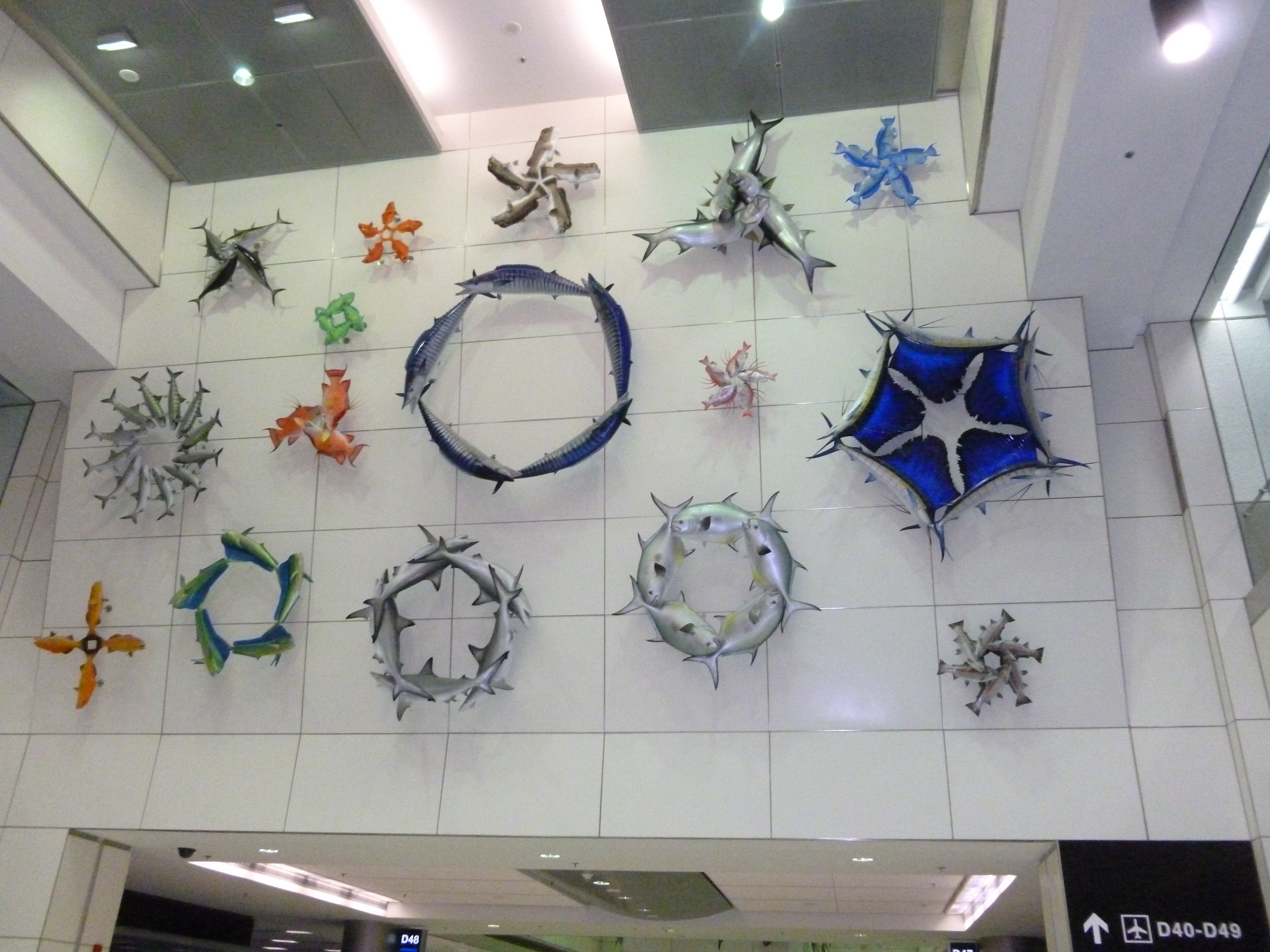
The flights were generally uneventful. We walked the entire length of the Miami airport during our 3 hour layover and saw some interesting oceanic sculptures.

Cool fish sculptures at the airport in Miami.

After a 9 hour flight we arrived at the airport in Montevideo. We spent almost an hour getting through customs. All flights coming into the airport are international and there isn’t a separate line for Uruguayan nationals. Everyone has to wait. So we waited. When we got to the customs desk the woman said “hola” and went right on bobbing her head and dancing to the radio she had. She ran our passports and said “adios”. She didn’t ask us any questions all all. We’ll go find the immigration office later to extend our visitor’s visas another 90 days.

We met Asa’s friend Nacho and his brother-in-law Sebastian in the airport. Sebastian owns a car. A special car; a bright orange hatch-back with fold down front seats as entry into the back. The shocks were shot, the radio was pulled out and the gas gauge was on perpetual empty. So we hopped in and had to put some of the bags on our lap because they wouldn’t fit in the trunk. After some confusion about how to get out of the parking lot (one too many “salida” or “exit” signs) we were on our way. Lane lines in Uruguay are just a suggestion which I’m sure will have it’s own post in the future. We took the Ramblas (the street that runs along the water) most of the way. We passed what looked to be nice beaches, but we’ll find out in the future I’m sure.

We got to our house and knocked on the door. A little boy answered and we asked for Raul Locatelli, our host. The boy didn’t speak english and got his older brother (maybe?) who spoke some english. He had never heard of a Raul Locatelli and no he did not live at that address. Well, had he heard of Maria, the other person in the housing complex? Well yeah. Maria owned the building and no she wasn’t there, but we could call her. Luckily Nacho took care of this phone call for us. He also tried calling the number we had for Raul Locatelli without any success. Maria has never heard of a Raul Locatelli and she only has a house full of Uruguayan students and does not cater to U.S. people. She says to try the hostel down the street.

Well Shit! Yep, Shit hit the fan… a really high fan!

Again, thank goodness Nacho and Sebastian were with us. We were able to call AirBNB (the company we rented through) and they got a hold of Raul Locatelli on his cell phone (we later learned that the number we had was his house phone) and connected us. Yes he did exist and just down the street a couple blocks from where we were. The address was just wrong on the website.

So we drove to the new address and sure enough, there was Raul Locatelli standing in the street waiting for us!