La Playa (i.e. the beach)

Our first visit to the beach was this weekend. People seem to flock to the beach on the weekends as early as 8:30 am. Most people just sit in chairs to sunbathe, but some wade in the water or play with a ball. We are a little dubious about the water quality, but are told the government says its safe to swim. The people we know here say they wouldn’t swim in it.

The beach has sand volleyball courts, tons of trash cans, porta-potties, and its’ very own ice cream man that yells “helados!” all day long. There are also a series of large poles, evenly spaced. They were obviously put there so that we could do beach workouts for ultimate. Right?

The beach looking back towards the neighborhood we live in.

View of the beach looking away from our neighborhood. I think all the flags are up for Carnival in 2 weeks. These are also a couple of the large evenly spaced poles I mentioned.

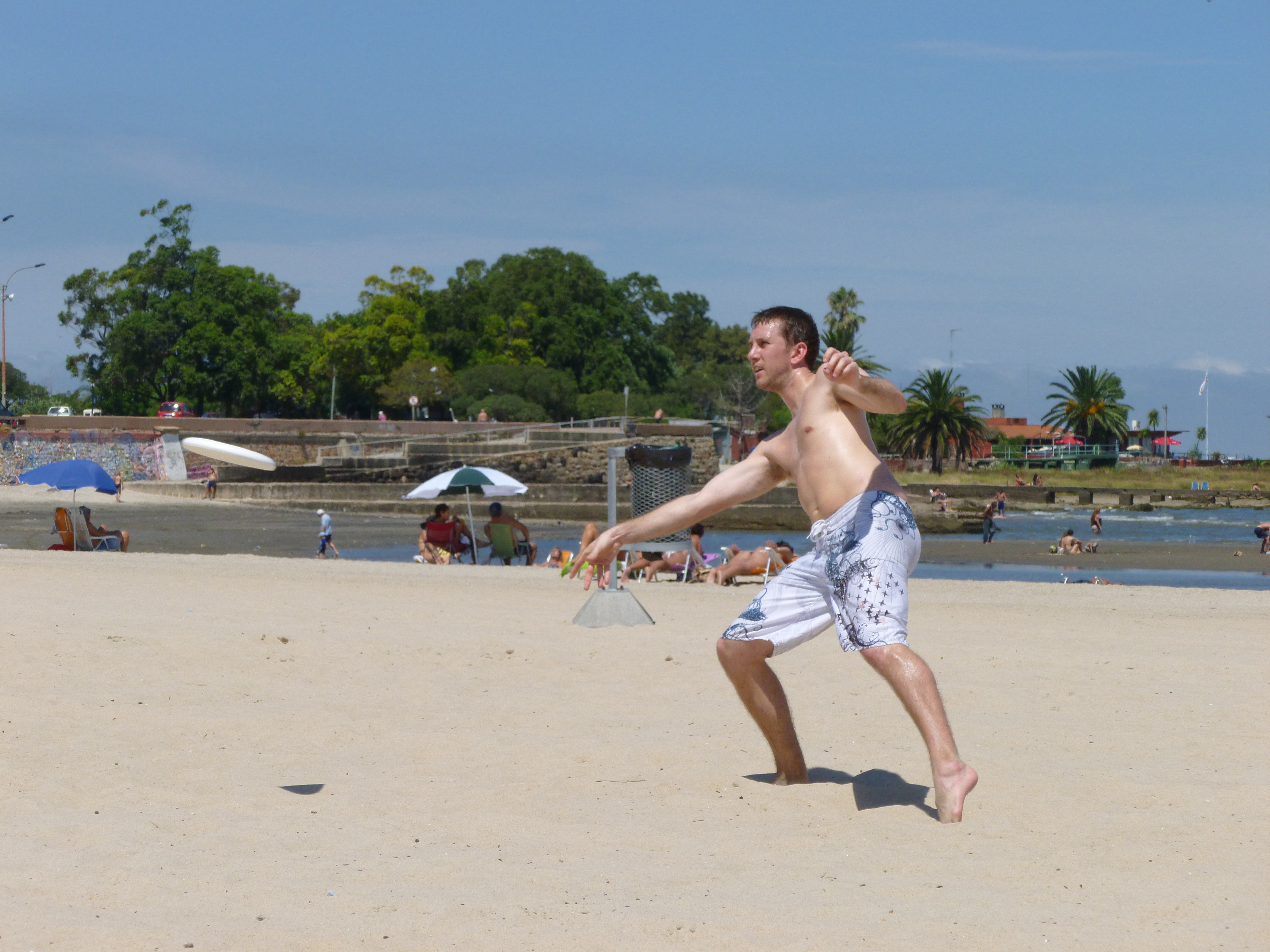
What did we do at the beach? What else would we do… We threw a frisbee. I think this more than anything else pegged us as tourists. That and the fact that we’re all so white. Step 1: Learn spanish. Step 2: get a tan.

Matt throwing a frisbee on the beach.

The Little House

Yep, that’s what Raul calls it… “The Little House”. When we finally made it to The Little House Raul had about 2 hours of instructions for us on how to take care of, and live in his house. He seems very nervous about renting his house out for the first time. Quite understandable. We assured him that we would take good care of his property. During our orientation he took us room by room telling us all about what we needed to do. Here is a brief recounting…

Entryway: There are two keys that were given to us for the two doors. There is a door that opens to the street and another door into the apartment. Between the two doors there is an atrium of sorts with a stairway up to the roof and some plants and such. Raul told us to be respectful of the space between the doors and to be quiet.

Looking out the window into the entryway. The doorway you see leads to the street and the stairs lead to the rooftop.

Living room: The living room has a cool tile floor, a couch, a chair, and a coffee table. There is also a TV with DVD player and cable which we’ll probably never use. There is also a stereo which Asa has promptly set up with our airport so we can play music through it from our computers. There is also a fire place which we’ll definitely never use, as its way too hot. Raul also directed our attention to an antique drum, a “candombe” drum, which is a traditional Uruguayan drum used during carnival. He told us under no circumstances, especially when we were drunk, were we allowed to play the drum.

The living room from the front door.

Atrium: The atrium is a great little place open to the sky and contains numerous plants. Raul gave us specific instructions on how to water the plants. This might be my biggest concern about The Little House. Asa and I have been known to kill bamboo (of course we didn’t tell Raul this). We’ll do our best. There is a beautiful table and set of chairs to use in the atrium but need to be brought in from the rain. Thus far, every day we’ve been here has had a chance of rain greater than 50%, but we’ve only seen a couple of drops. Guess we’ll figure out when it’s actually going to rain once we’re more familiar with the weather patterns.
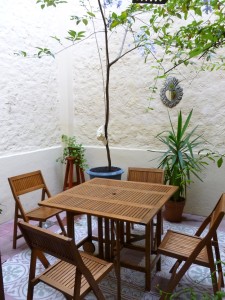
Table and chairs out in the atrium.

View of the atrium from an upstairs bedroom window.

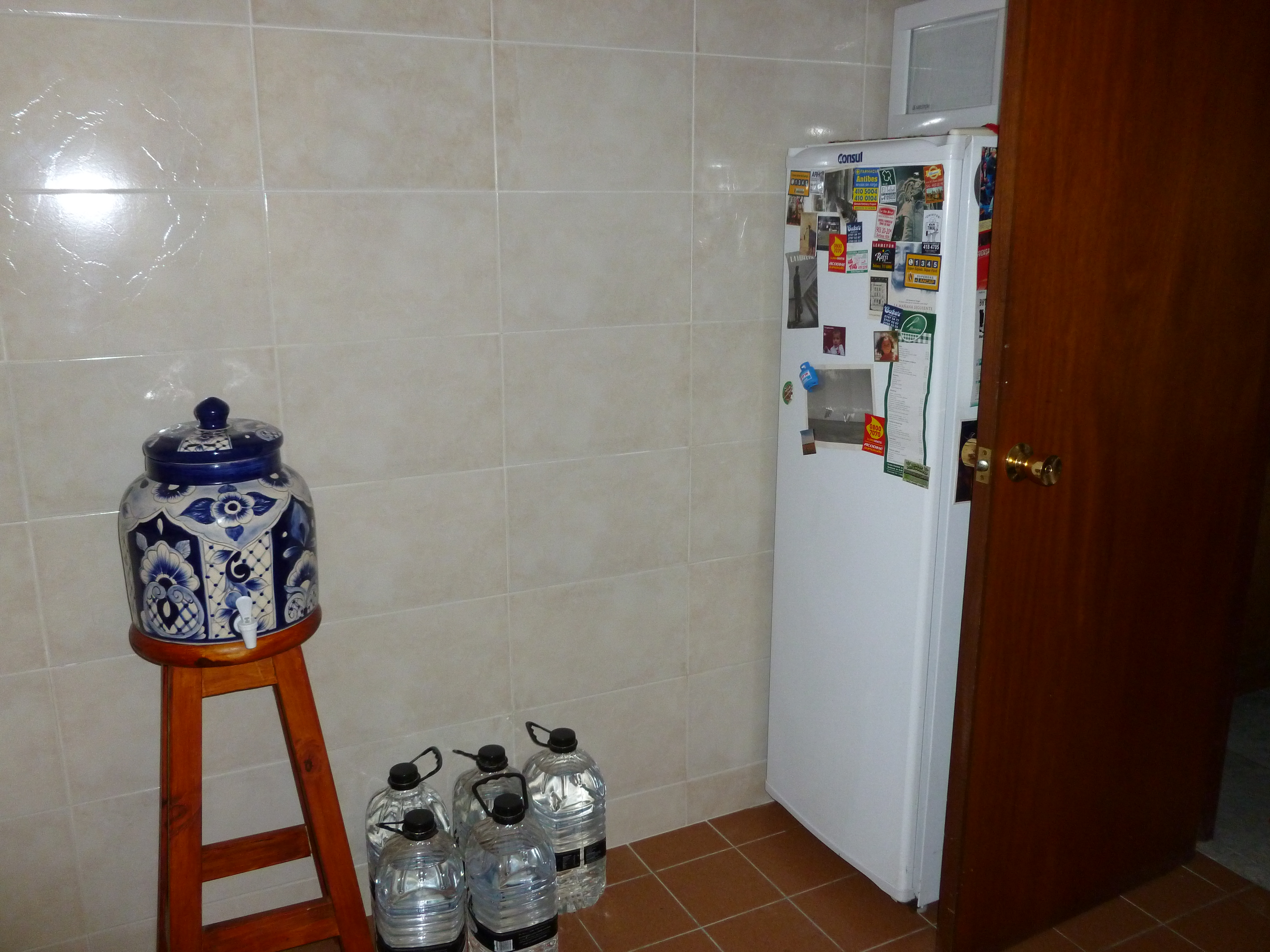
Kitchen: It’s tiny. There is a new, small gas stove with burners, a sink, minimal counter space, a small fridge, a microwave, a toaster, and a hot water pot. The Little House  and its water tank are almost 100 years old, so Raul recommended not drinking the tap water and instead buying bottled water. There is a large ceramic jug with a spout on a stool for this purpose. Raul also has a collection of glasses and has requested we use the ones that are not part of any sets, that way its not so bad if we break them.

The kitchen featuring the new little gas stove and the door into the atrium.

Yes, this is all the counter space we have!

The water jug and our half-size fridge.

Bathrooms: There is a full bathroom upstairs and a half bath downstairs. Both toilets have a holding tank and flush on the wall above. It takes forever for the tank to refill after its been flushed. We’ve also been warned not to put too much paper down the toilet. What “too much” is, is a mystery I hope we never solve.

This is the upstairs toilet and shower. Yes, that is yet another live plant we'll try to keep alive!

Bedrooms: There are three small bedrooms upstairs. A somewhat larger bedroom has a queen bed and a somewhat smaller bedroom has a twin bed. Both beds have a mosquito net hanging from the ceiling, although we’ve only seen a couple of mosquitos. We keep the windows open all day and night so the house can “breathe”, so the mosquito nets can’t hurt. Both of these bedrooms have windows that open to the atrium. The third bedroom is an office with a desk. Its’ windows open into the entryway and it’s darker than the other two rooms for most of the day.

The master bedroom.

This is the office.

Rooftop: In the entryway there are stairs leading up to the communal rooftop (there are two other apartments in the house). The stairs have a locked gate at the top so that no one can get into the house from above. On the roof there is a table and chairs, a place to hang a hammock, and a space to grill. The grill is old-fashioned and necessitates building a fire and placing meat over the flame. There’s not much of a view from the roof, as all the buildings are about the same height and the streets are lined with trees.

The rooftop. The gate on the left leads down the stairs into the entryway.

All in all… It’s a pretty awesome little house.
Planes, Trains, and Automobiles: Our Journey to Monetvideo

The day started off exactly as planned; with the alarm ringing at 5:15 AM. All of us, grandma included, piled into the prius with all our stuff and drove to the train station where we took the obligatory picture of us with all our stuff. I’m sure it’ll make the holiday card next year.

The "before" picture

The train was on time, as it should be at the start of the route, but is hardly ever true for the rest of the stops. We said our goodbyes and waved and blew kisses (well I did) from the train window and we were off. After collapsing into an early morning nap for about an hour, we woke up to the ocean and dolphins. The Pacific Surfliner is definitely best when experienced from the west side of the train, as it hugs the coastline between Lompoc and Oxnard. The train ride was uneventful just as we had hoped and we even arrived at Union Station in Los Angeles on time. We managed to find the baggage claim. “Past the Subway sign” the Amtrak worker told us. We were really confused until we saw the sandwich shop.

This brought us to the part where I (along with many others) broke Asa’s bag (see his previous post). The baggage claim at Union Station happens to be at one end of the station and the FlyAway Bus (to LAX) at the other. The Station isn’t big but has a very European feel to it and it was big enough for us to just miss the FlyAway bus. Luckily they run every 30 min. Neat, efficient, and cheap (only $7) system they have. Would recommend it to anyone traveling from Union Station to LAX. Out of curiosity, we estimated their profit before overhead to be somewhere in the ballpark of $7000 a day just for their Union Station location.

We made it to LAX after an uneventful ride on the FlyAway bus. We found our way to the departures and the hotel shuttles. Hotels in the LAX area have banded together in an effort to reduce pollution and now shuttles service multiple hotels. Super idea! We found ourselves at the hotel and checked into our room by 2 PM. We grabbed some food and went to find Asa a new suitcase. Fun!

The next day, Jan 31 was our big travel day. LAX to Miami to Montevideo and about 18 hours of travel time. I think we set a new record that morning by making it from our hotel room to our gate at the airport in under 30 min. We had planned on giving ourselves some time in case it was busy, so we ended up sitting at the gate for a long time. Better than the alternative.

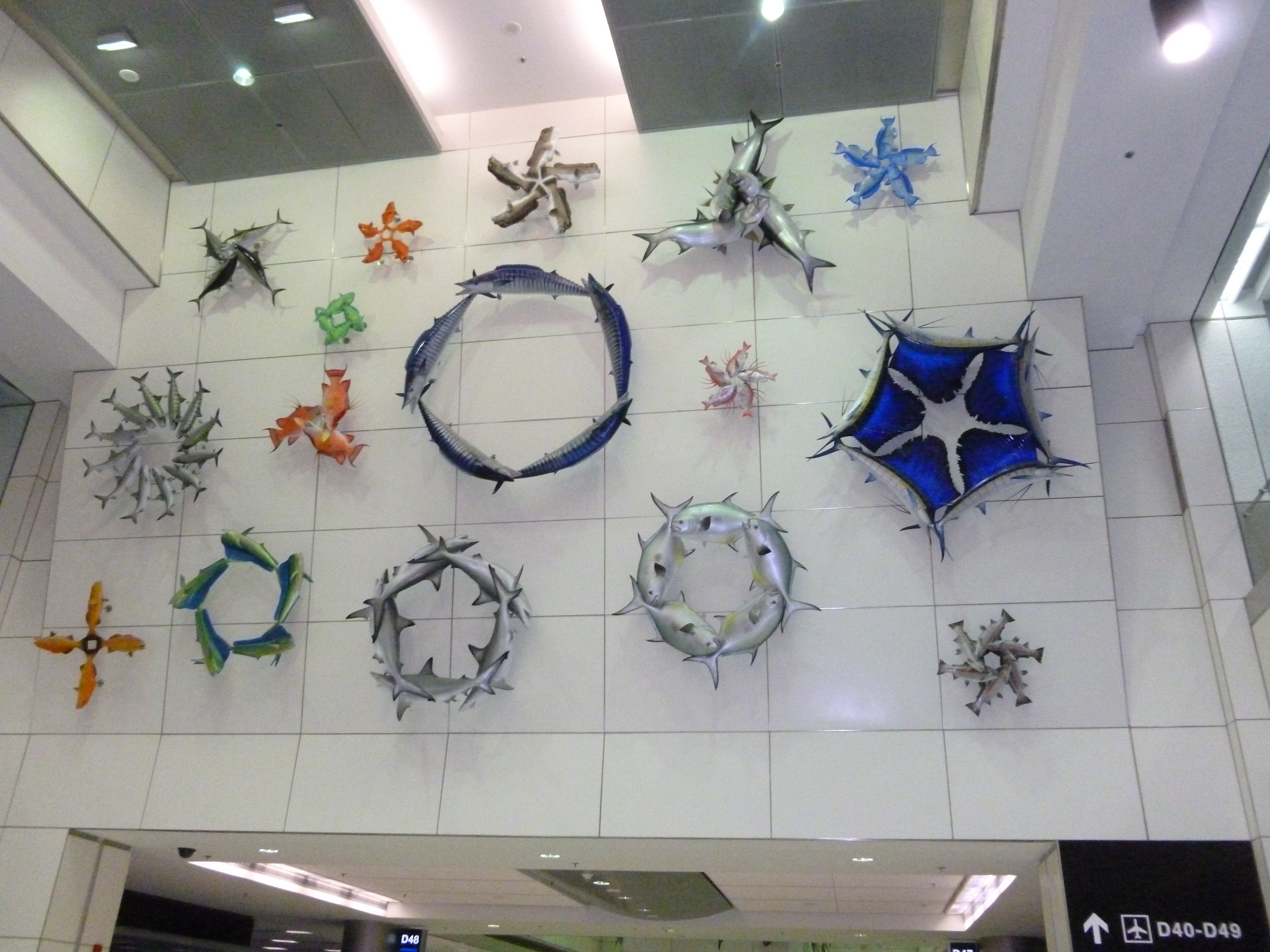
The flights were generally uneventful. We walked the entire length of the Miami airport during our 3 hour layover and saw some interesting oceanic sculptures.

Cool fish sculptures at the airport in Miami.

After a 9 hour flight we arrived at the airport in Montevideo. We spent almost an hour getting through customs. All flights coming into the airport are international and there isn’t a separate line for Uruguayan nationals. Everyone has to wait. So we waited. When we got to the customs desk the woman said “hola” and went right on bobbing her head and dancing to the radio she had. She ran our passports and said “adios”. She didn’t ask us any questions all all. We’ll go find the immigration office later to extend our visitor’s visas another 90 days.

We met Asa’s friend Nacho and his brother-in-law Sebastian in the airport. Sebastian owns a car. A special car; a bright orange hatch-back with fold down front seats as entry into the back. The shocks were shot, the radio was pulled out and the gas gauge was on perpetual empty. So we hopped in and had to put some of the bags on our lap because they wouldn’t fit in the trunk. After some confusion about how to get out of the parking lot (one too many “salida” or “exit” signs) we were on our way. Lane lines in Uruguay are just a suggestion which I’m sure will have it’s own post in the future. We took the Ramblas (the street that runs along the water) most of the way. We passed what looked to be nice beaches, but we’ll find out in the future I’m sure.

We got to our house and knocked on the door. A little boy answered and we asked for Raul Locatelli, our host. The boy didn’t speak english and got his older brother (maybe?) who spoke some english. He had never heard of a Raul Locatelli and no he did not live at that address. Well, had he heard of Maria, the other person in the housing complex? Well yeah. Maria owned the building and no she wasn’t there, but we could call her. Luckily Nacho took care of this phone call for us. He also tried calling the number we had for Raul Locatelli without any success. Maria has never heard of a Raul Locatelli and she only has a house full of Uruguayan students and does not cater to U.S. people. She says to try the hostel down the street.

Well Shit! Yep, Shit hit the fan… a really high fan!

Again, thank goodness Nacho and Sebastian were with us. We were able to call AirBNB (the company we rented through) and they got a hold of Raul Locatelli on his cell phone (we later learned that the number we had was his house phone) and connected us. Yes he did exist and just down the street a couple blocks from where we were. The address was just wrong on the website.

So we drove to the new address and sure enough, there was Raul Locatelli standing in the street waiting for us!

Pets Adjust To Their New Home

I know a lot of pet lovers out there that worry about their pets. Sometimes pets seem like children. We worry about them; we want them to be well taken care of. We don’t want them to be sad or to miss us while we’re gone regardless of the time-span. So traveling for long periods of time can be stressful for pet owners.

The first thing to think about is who you trust with your pets and who would want to keep your pets for the length of your traveling. For us there was only one option: parents! I mean really, what other suckers will take in a dog (Cattle Dog) and cat (Crazy Cat) for 6 months and love them as they would their own. Luckily, we have been able to stay with my parents for more than a month to help with the adjustment.

This brings me to the zoo. My parents already have a dog (Big White Dog) and a cat (Old Man Cat). Bringing our pets into the mix has resulted in quite a few changes around the house.

1. The house erupts in barking whenever anyone thinks about walking near the house, a dog hears a strange noise, or someone knocks on the door. Cattle Dog isn’t used to barking at people outside windows, but she very willingly joins in the ruckus.

2. The cat food can no longer be kept on the floor. The Big White Dog is terrified of clanking sounds that dishes make, so it was safe to keep the Old Man Cat food in a little bowl on the tile floor. Big White Dog wouldn’t go within 5 feet of it. Cattle Dog, the newcomer, doesn’t have any qualms about noise so the food had to be moved.

3. Exercise needs to be coordinated. People cannot be outnumbered by dogs, especially not these dogs. Cattle Dog is a born herding dog. She will herd other dogs, people, bicycles, horses, cats, and really anything else that moves in an effort to exhibit how good her genetics are. She needs to be watched with at least two eyes.

4. Food no longer flows from the table into the Big White Dog’s mouth (much to her disappointment). Cattle Dog doesn’t get much human food and the small scraps she does get come from the kitchen. This has been the hardest adjustment for the parents. We keep telling them that those big brown eyes are lying.

5. Big White Dog has become much more active (although part of this might be the 20+ glucosamine pills she found on the floor, care of Crazy Cat knocking them off the shelf). The two dogs have become playmates; they may even become besties while we’re gone.

6. Old Man Cat is angry. He is set in his ways and doesn’t appreciate Cattle Dog’s herding efforts. He has taken up residence under the parents’ bed and sneaks outside under the cover of darkness. Hopefully he’ll join the rest of the family soon.

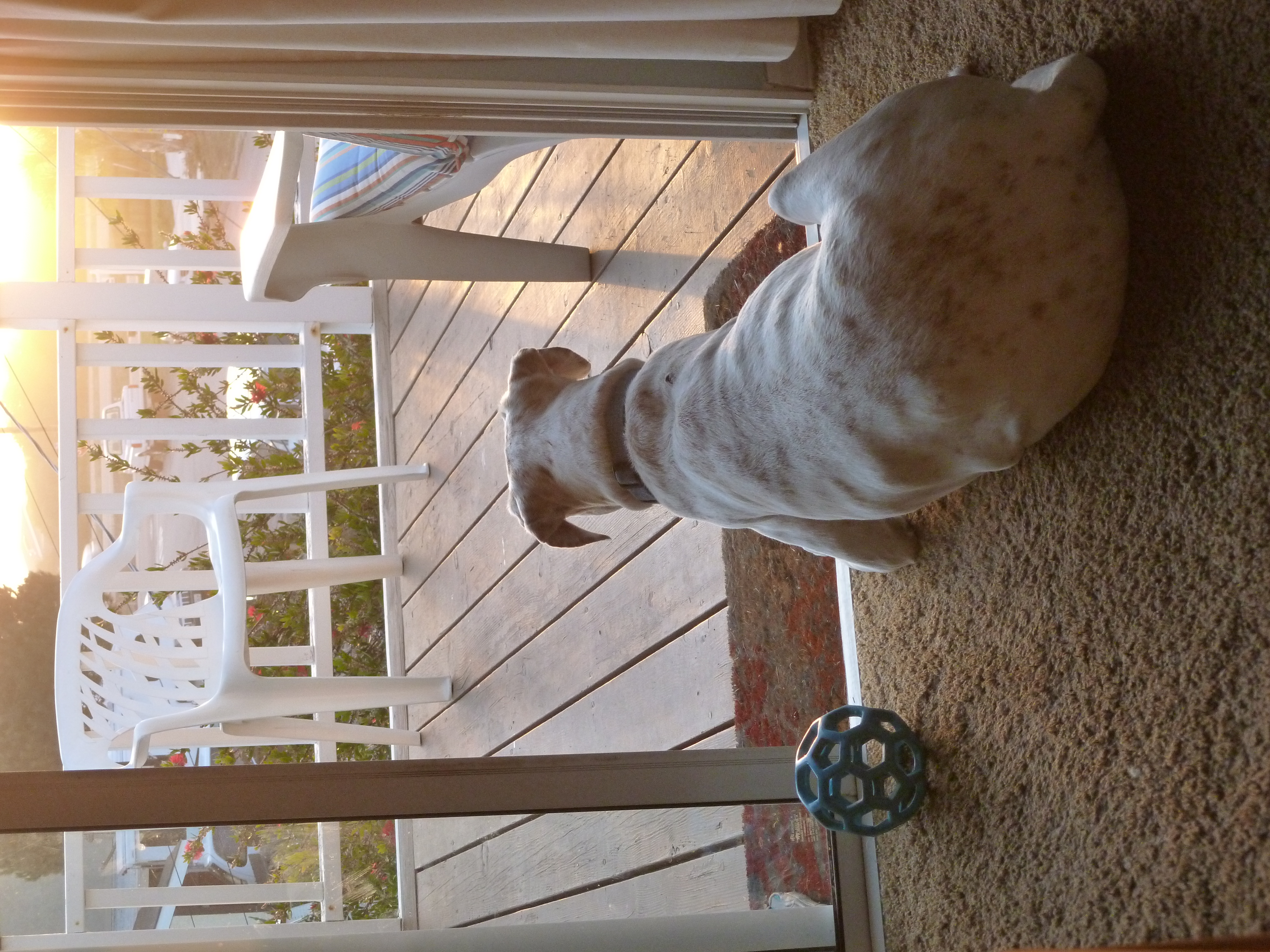
Here are some pictures to sum up the dogs’ behavior. Big White Dog sits and watches while Cattle Dog wants to play (always!).

Preparation: A Whole New Beast

The longest trip away from home that I ever took lasted about 2 months. I don’t remember doing anything special. I stuffed all my clothes in a backpack and went. I didn’t have trip insurance, I didn’t look into special health care options, I didn’t cancel my mail or sell my car, I didn’t worry about how to get money, and I certainly didn’t try to learn any new languages. This trip is a whole new beast.

Below is an account of only some of the organizational things we have thought of in preparation for our trip:

Permanent residence: We do not own a house and I imagine there are very few reasons why someone would be compelled to maintain two rentals simultaneously. So we moved out of our rental house. Our nearest family lives in an adjacent state. Graciously, we were allowed to store the aftermath of our minimalist endeavors in their garage. We changed our permanent residence to match the location of our stuff. Some things we had to consider were: Change of addresses (U.S. Postal Service can be done online for a $1 fee and they will forward your mail for up to a year), driver’s licenses (A note from a family member confirming that we were actually moving in and two bills in their name seemed to be sufficient), voter registration (can be done at the DMV), and car registration (we decided that selling our cars would be a better option).

Health Insurance: It turns out that health insurance must match the state in which you are a permanent resident, so we had to make some changes. We enlisted the help of a health insurance agent who was certified through a variety of agencies. He was able to put together various quotes for different policies and look into policies that specialize in international travel (without any success). European health care is familiar with insurance companies in the United States, but we were told all bets were off in other areas of the world (i.e. the ones we’ll be visiting). We will probably have to pay up front for any medical care and file claims with our insurance later. We are currently looking into additional trip insurance with a medical evacuation rider in case we need to get back to the states in an emergency.

Money: ATM fees, international credit card fees, international bank fees? We are currently undecided as to the best and cheapest way to get our money abroad. We have been told from other reliable world travelers that getting as much cash out of an ATM at a time and doing this as infrequently as possible is a good way to keep a handle on fees. Also we’ve been told to avoid using credit cards because the fees are really high, although at this point it’s just hearsay. Also, if you are going to order currency prior to your trip you can do so through your local bank, but it could take up to two weeks for “unpopular” countries.

Again, these are just a few of the things that we’ve thought of before our trip. There are numerous other things that we have either thought of and dismissed, or haven’t thought of and will come back to haunt us in one way or another.

Our Journey Begins

Our journey really started early one Saturday morning. We had already moved out of our house, secured our furniture and belongings in my mother-in-law’s garage, and dealt with all the associated paperwork. We loaded our car while it drizzled. The dog came willingly; the cat was probably saying F you. Luckily they are both fairly good travelers. The dog usually observes… everything! When she gets tired she lays her head on one of the front seats and observes. The cat just stays quiet. Whether this behavior is the result of complete terror or apathy is unknown, and frankly, it doesn’t matter.

Asa drove. We managed to avoid the pothole on the freeway in town that claimed my hub cap last week, but after that I don’t remember much until I woke up in Alabama thinking I must be going crazy because the clock only said 9:15 AM. Oh time changes. Asa and I fortified ourselves with a stop for Hardee’s breakfast, switched drivers, and soldiered on. We had a good laugh when we passed Chunky, Mississippi and had a good time trying to guess the equipment being hauled by big rigs. We crossed the Mississippi River in the late afternoon with the sky as blue as the river. At the day’s close we found ourselves 100 miles into Texas at a La Quinta and walking to a nearby mexican restaurant for dinner.

Day two started by scraping a thin layer of ice off the windows of the car and trying to figure out the most efficient way to put things back in the trunk. Our only goal for the day was to make it out of Texas; a formidable task when one starts the day at mile marker 556 and there’s still 200 miles on another highway to make it out of the state. Luckily, the speed limit was 80 mph. It’s not surprising, considering that there’s nothing there. We passed through Dallas and Fort Worth which were pretty much the end of civilization as we know it and the beginning of small run down towns with cars on poles advertising long defunct garages. Just outside El Paso and Ciudad Juarez we began to see Border Patrol everywhere. Going the opposite direction they stopped and searched every vehicle. Our day ended with a half hour of meowing from the cat (we didn’t blame her; being stuck in a car carrier for 12 + hours can’t be a fun experience) and a sign saying “Welcome to New Mexico”.

By day three we had no desire to get in the car again, let alone drive the entire day. Also, the weather threw us a curveball, or should I say some snow flurries and 35 mph winds. As luck and planning would have it, we managed to avoid traveling on Highway 40 through Flagstaff and Albuquerque, which received enough snow to close down parts of the highway. Asa managed to keep the car going in a straight line at a good clip, although passing some of those 18 wheelers was a bit hairy. We made it to Tuscon in time for lunch and continued on. We saw more cops on the road this day than we had seen in the last two, most of them in Arizona. Asa drove for most of the day in an effort to conquer some demons from his past. Two of his friends died in a car accident on Highway 10 between Pheonix and Indio a couple years ago. They will always be missed.

Day three ended at the only place (or what felt like the only place) in the Indio/Palm Desert/Palm Springs area that allows pets without charging an arm and a leg. We walked to get Italian food and then crashed in our hotel room watching “The Blind Side”.

Day four started unexpectedly early (4 AM early) with the cat knocking change off the table, jumping on and off the bed, and being generally annoying. We tried various ways of silencing her until we decided that it might just be a good idea to get up and get on the road before we went crazy. Unfortunately, no matter how early in the morning one tries to get through Los Angeles and it’s associated suburbs, one always gets stuck in traffic. We played a little freeway hopscotch with the help of Asa’s IPhone and the carpool lane and made it out of the chaos before 8 AM. We made it to our destination a bit earlier than expected; safe and sound, and very tired.