Fútbol Game!

Last night Asa and I were lucky enough to attend a local fútbol game. Our friend Carlos won some tickets to the game and invited us along for the fun!

Just a quick note about fútbol outside the United States and in Uruguay. Fútbol is a “national pastime” in many countries and in Uruguay especially. The Uruguayan Futbol Association (the country’s governing body for the sport) was founded in 1900. The national team has won the World Cup twice; once in 1930 during the first World Cup Tournament (also held in Uruguay) and again in 1950. They came in 4th during the 2010 World Cup and have won the Copa América a record 15 times, including in 2011. The success of the Uruguayan national team has been cited as amazing by many in the press because of the country’s small size (about 3.5 million people). Check out the great info about the team on Wikipedia.

In short: Fútbol is important here. Children start playing in local leagues when they are very young (i.e. when they can run and not fall over immediately) and they keep playing. There are numerous teams in the country’s professional league, the two most popular being “Nacional” and “Peñarol”.
When there are important games on television the city stops functioning (literally). Carlos told us that people will leave work early, stores will close, and people can only be found where they can see the game (i.e. at home or in bars). This type of interest/obsession with a sport can only be rivaled in the United States by the Super Bowl, which comes in at a very very distant second.

The game last night was Nacional vs. a team from Chile. It was one of several games in the Copa Santender Libertadores that occurs from January to July and involves teams from 11 South American countries. The game was at the open air Centenario Stadium. On our way to the stadium a crowd of fans from Chile were walking down the middle of the street yelling and carrying on, stopping traffic. Of course this was about 2 miles from the stadium.

The turn-out for the game was pretty poor because of a cold rain forecast in the weather. We went prepared with raincoats, thick socks, and beanies. Despite the small crowd as a whole, the die-hard fans were there in throngs. Clubs in the city get together and get seats behind the home-side goal, where they spend the entire game singing, dancing, lighting flares and small fireworks, and in general being the “life of the party”.
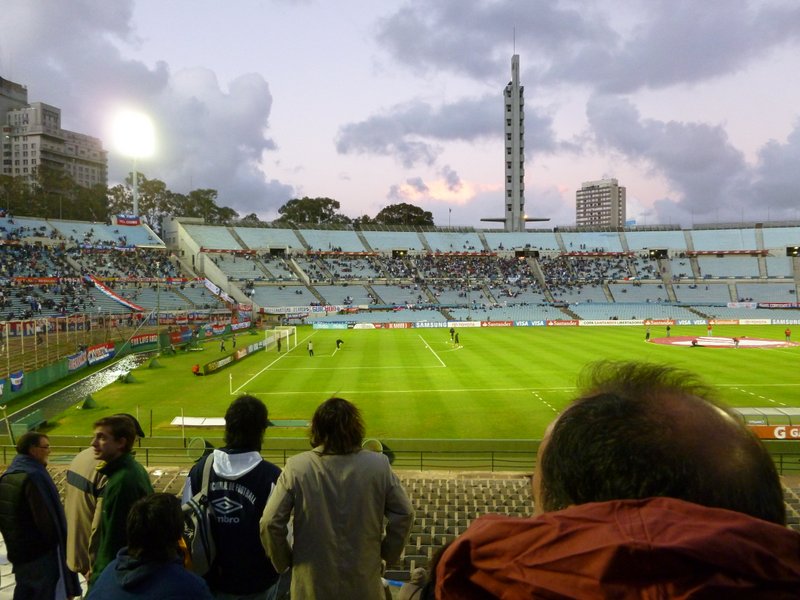
There was a huge fireworks display as the home team, Nacional, took the field. Carlos said that sometimes they fire off so many that they have to wait for the smoke to clear before they can start the game.
Vendors walk around the stadium selling various things to eat including: potato chips, peanuts, coffee, tortas fritas (fried bread), and sodas. Just like anywhere else, prices were a bit more expensive than in the supermarket or local corner store. There were police patrolling everywhere, but weren’t checking bags or preventing people from bringing things into the stadium. We brought some sandwiches and cookies.

The game itself was fairly frustrating. The home team, Nacional, had a ton of shots on goal and runs down the field, but for whatever reason couldn’t score. There were lots of yellow cards. A man sitting behind us even yelled “tarjeta (i.e. card)” every time a player hit the ground. I guess that’s part of the recent efforts to try and crack down on fouls in the game. Nacional managed to score in the second half with a nicely deflected ball from the heel of a foreword; home team wins 1-0.

The game was a blast. Asa and I are looking forward to other games, as we imagine each game has a different “feel” based on who is playing and the weather. We really want to see a Nacional vs. Peñarol match. Here’s to hoping that there will be one while we are here and that we can get tickets!

Check out some short videos I took with my camera: Video 1 and Video 2.
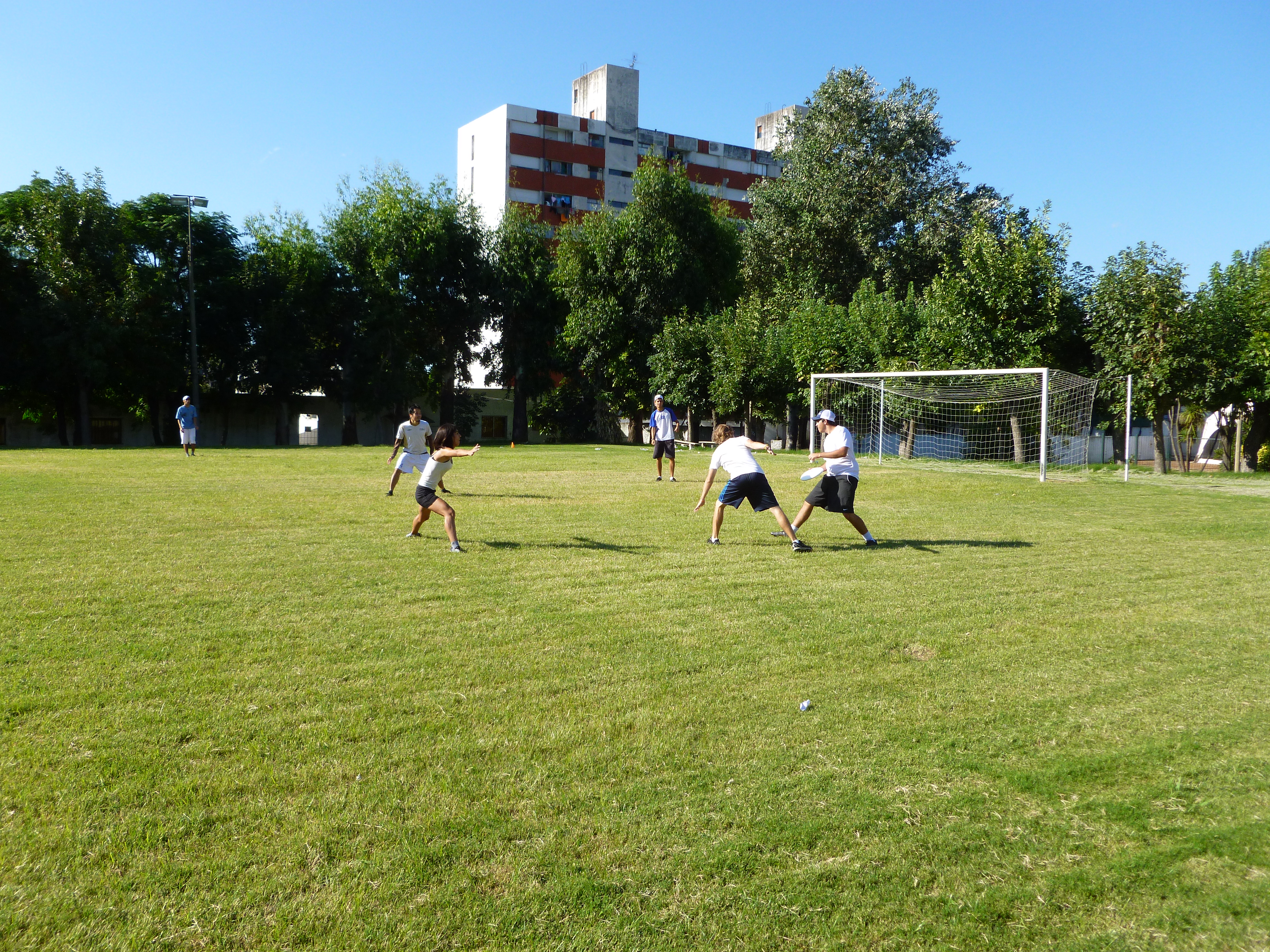
Tournament Practice!

The Uruguayan ultimate team will be playing in a big tournament in Buenos Aires, Argentina April 5-8. We have been helping them prepare by teaching them the fundamentals of the sport along with strategy and plays.

The team normally has practice on Tuesday, Thursday and Saturday afternoons. Attendance on Tuesday and Thursday is usually scant because people have school and work commitments in the afternoon. Saturday is advertised as a “come one, come all” and learn about the sport of ultimate day. Amazingly, there is usually one or two people every Saturday that are new to the sport. Kids show up to learn as well as teachers, making ultimate an all-inclusive and enjoyable sports experience.

As the teams’ goal is to win some games and do well at the tournament, we as “coaches” suggested that we have a team practice on Sunday afternoon for all the people that will actually be playing at the tournament. We felt that it was important so that the team could learn how to play with each other, and it would be a good opportunity for learning tournament-specific information (like plays).

So last Sunday (March 18) we had our first practice as a team! Carlos was able to secure some nice fields for us to play on at the local military school/base. The fields were nicer than many of the fields in the United States that are used for practice and tournaments. Nice fields go a long way to running hard, laying out, and feeling like a team!

The practice was wonderful! Everyone was focused and eager to learn. We practiced movement and timing of the cuts from a vertical stack, cup movement for zone defense, and reading the disc in the air. It was really productive and everyone had a great time!

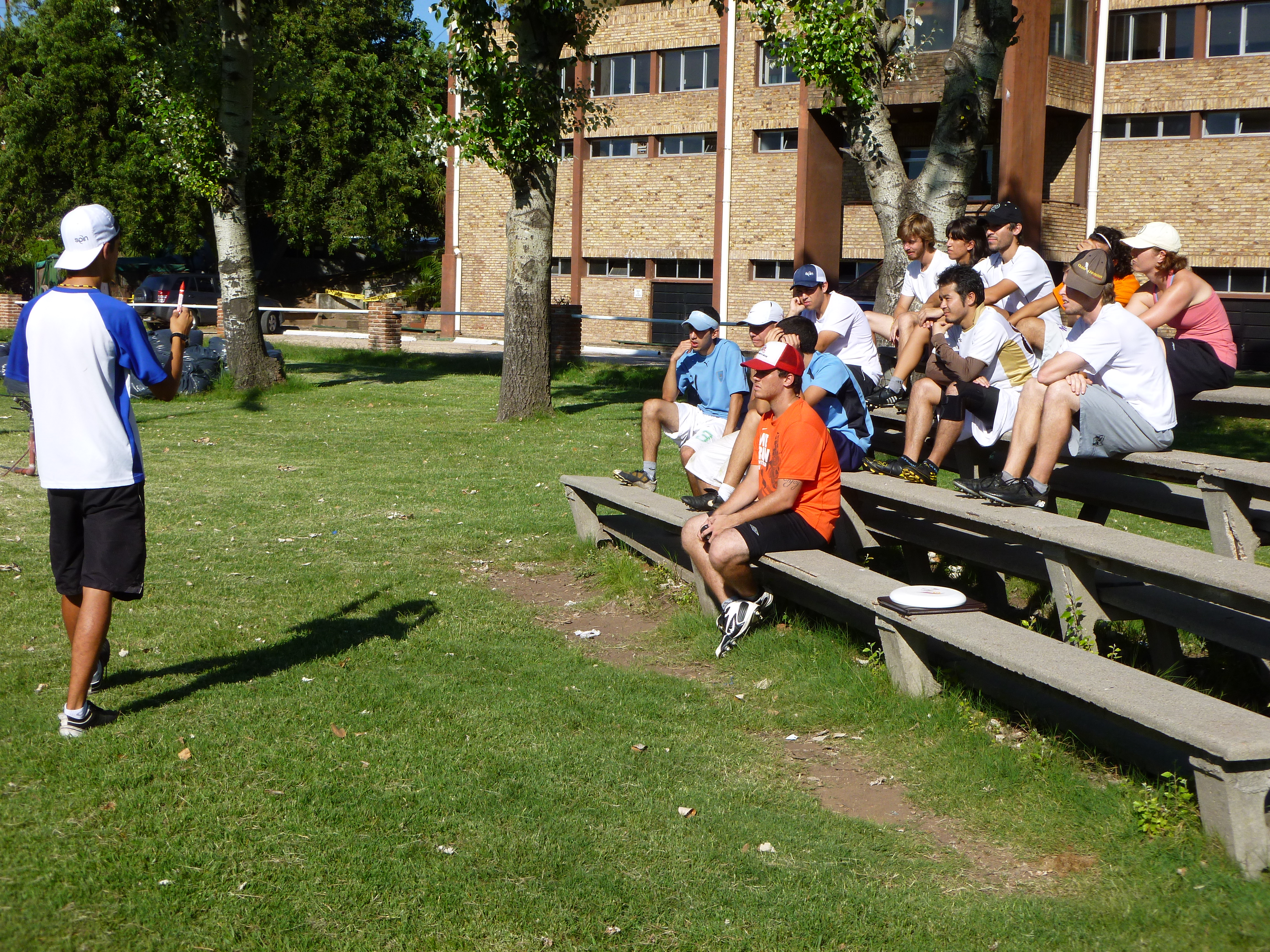
Juanma (Carlos' brother and fellow captain) reviewing zone defense for the team.

Chandro throwing upfield.

We had another practice this past sunday (March 25) to work on plays on the field and in the end zone.

We are super excited about the tournament in a couple weeks! There is no doubt about the potential of this team. They have improved immensely since we arrived and have transformed into a competitive ultimate team. There is also no doubt that when we leave they will continue to improve and grow the sport of ultimate here in Uruguay!

Vaccinations

Sorry we’ve been MIA for a while. Nothing bad has happened, but we’ve neglected the blog a bit in favor of interacting face to face with people. This has resulted in a bunch of posts that will be forthcoming, so stay tuned. We’ll start with today’s adventures and work backwards in the coming days until we’ve caught up!

“Vaccinations” might be an odd title for this post considering that we’re not little babies any more and we’re not traveling to any crazy places. Uruguay is not a third world country and does not have any crazy disease carrying monster insects. Well, turns out that we will be traveling to a crazy place with crazy disease carrying monster insects while my parents are here visiting in a couple weeks.

We are traveling to Iguazu Falls which is in the northern-most part of Argentina and borders Paraguay and Brazil. It’s the jungle and the mosquitos in that jungle sometimes carry yellow fever. It is recommended for people traveling to this area to get vaccinated for yellow fever, but it is not required. See these sources about yellow fever and where vaccinations are required: National Institutes of Health and Vaccination Info. Since yellow fever is a very serious disease and at the request of my parents, we got vaccinated for it.

Montevideo has a dedicated office at the port for travelers who want to be vaccinated against yellow fever. I imagine this is because there is a very real risk of yellow fever in many northern parts of South America and many countries require travelers to be vaccinated against it before being granted entry into the country. This is definitely the case for travelers to Brazil.

So what does one do to actually get vaccinated for yellow fever? Well it’s a four step process. The first step is a phone call. This was a very interesting step considering my tenuous understanding of the spanish language and the lack of facial expressions and hand gestures for contextual support. After figuring out how to actually make a phone call on my cell phone (dial 0 and 2 before the number in case you’re wondering), I fairly easily stated what I was calling about, told the nice lady where we were traveling, and set up an appointment for 9 am Friday morning.

Then she said she had some questions to ask me. I understood that, but could not for the life of me comprehend the actual questions she asked me. This became apparent fairly quickly and she handed the phone to a man who’s english was just as bad as my spanish. After some exchanges in “spanglish” I managed to answer the questions to his satisfaction and he wished me happy travels and hung up.

The second step in getting vaccinated against yellow fever is to figure out where the heck the office is. The office of “Sanidad de Fronteras” is at the port of Montevideo, which is a fairly large place. There is a cruise line terminal, the buquebus (boat to Argentina) terminal, and a variety of large and imposing brick buildings. On google maps it was very clear where we were suppose to go. Unfortunately reality sometimes doesn’t look like google maps.

What did we do? We asked someone who said to go until reaching the big brick building and the office was at the end. He also pointed in the direction we should be going. At the end of this brick building there was a pair of glass doors that looked like it could be a doctor’s office. We went in and asked again and were told it was around the corner. As we were walking out one of the dock crew smiled and pointed around the corner. Guess we’re just that apparent.

Looking toward the end of the very large brick buildings. The Sanidad de Fronteras is at the very end!

Well we got to the unlabeled door around the corner and went in. Signs were plastered everywhere saying that the yellow fever office was on the first floor, so we went up.

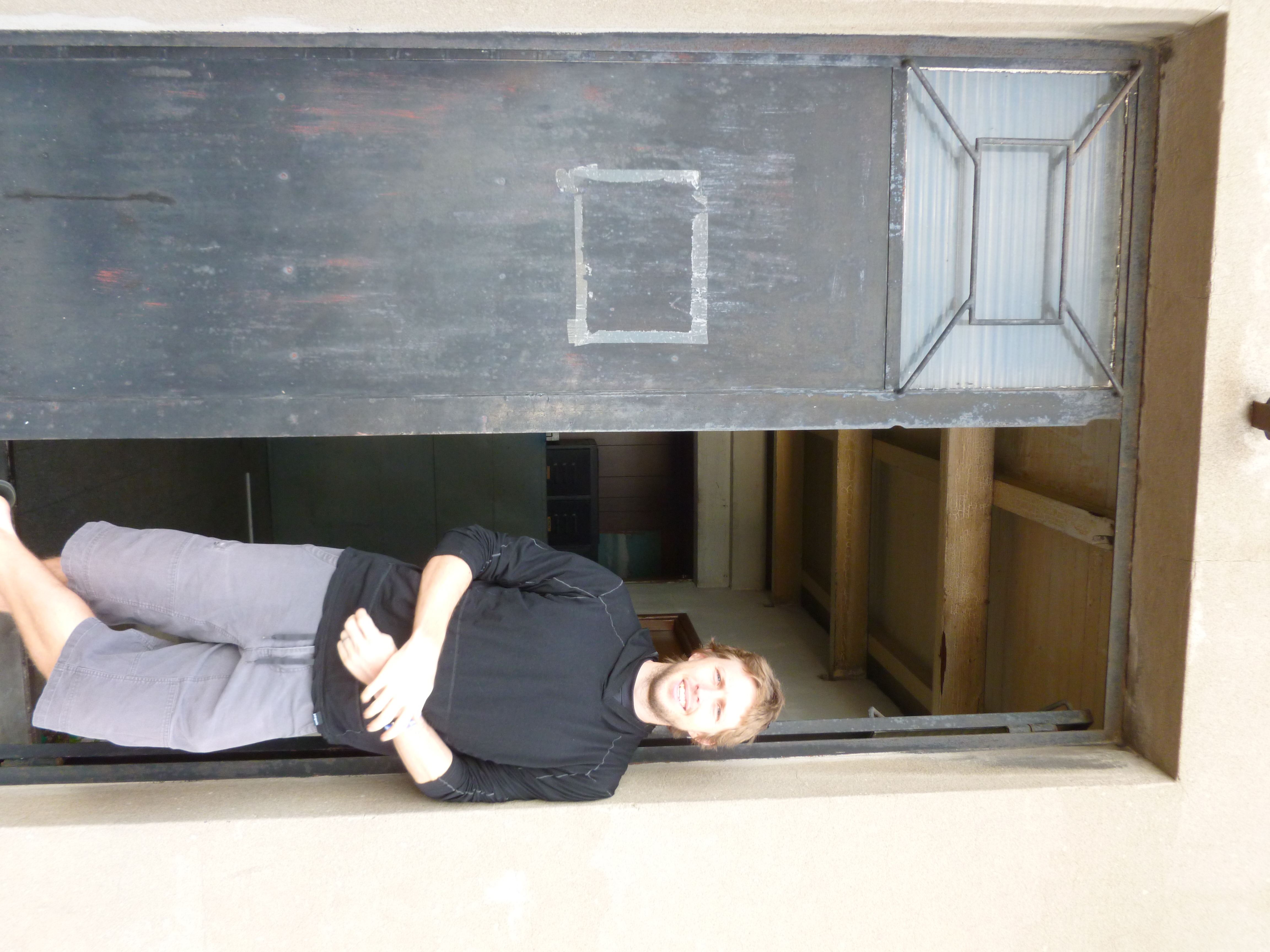
The unmarked doorway to the vaccination clinic.

Signs posted up in the office.

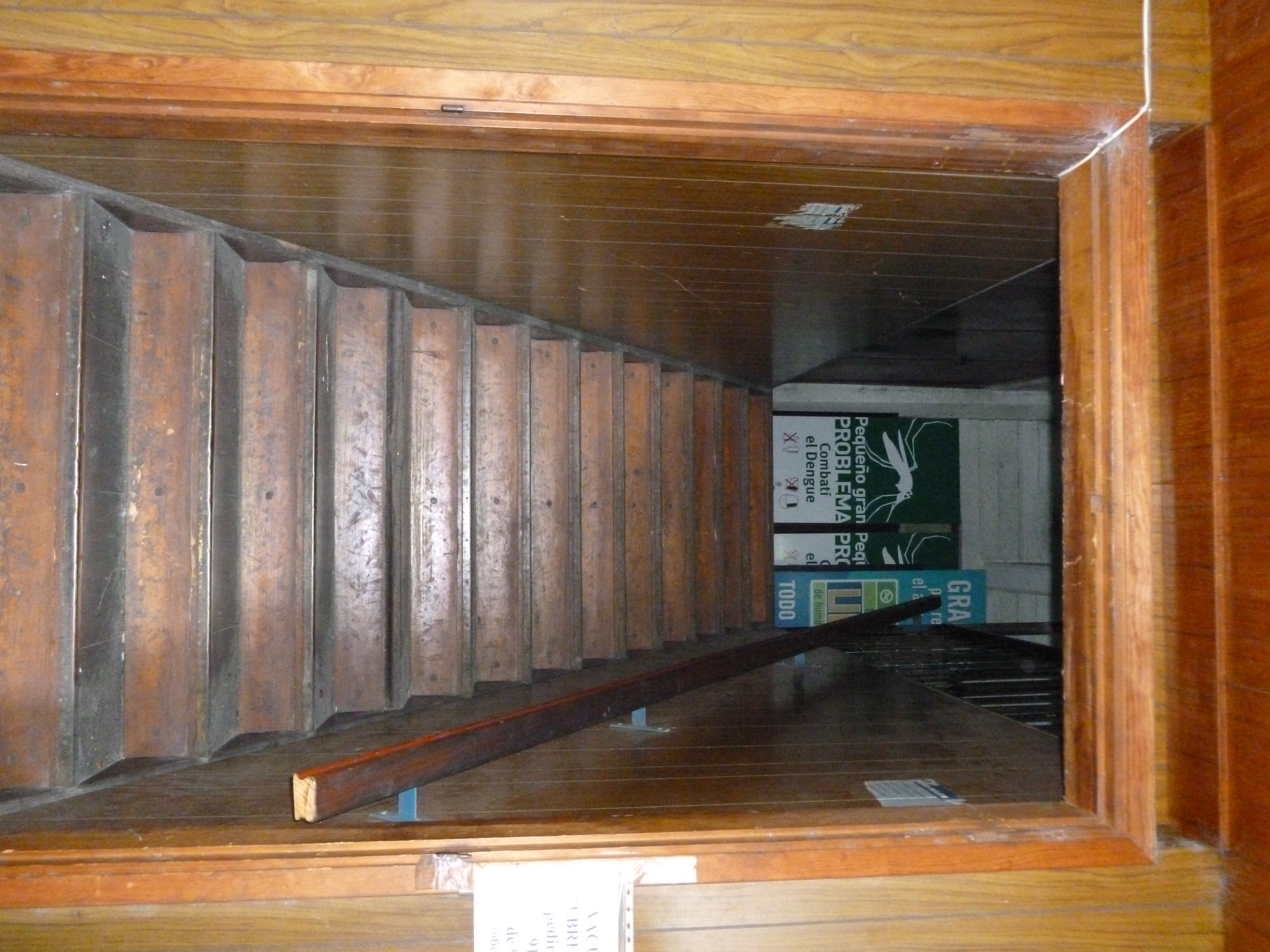
Stairway up to the vaccination office.

The third step in getting vaccinated against yellow fever is waiting to get the shot. On going upstairs, we found ourselves in a dark foyer with several closed office doors (looking deserted), a locked bathroom, and one door in the corner that said “Fiebre Amarilla” (i.e. yellow fever). There were 5 people already standing in the foyer. They had all made appointments for 9 AM and were upset about having to wait in line and apparently it doesn’t matter if you make an appointment because they just call the next person in line.

While we were waiting the man behind us saw our passports and asked incredulously if we needed them, at which time we told him that we were from the United States and that we were told to bring them. Our answer quelled his fears and he asked us where we were traveling.

The fourth step in getting vaccinated against yellow fever is actually getting the shot. We were called into the office which consisted of one room containing three people: a woman acting as receptionist, a man answering phones, and a nurse. The room had a couple desks which the first two people were sitting at and a corner with a curtain where the shots were actually administered. The nurse was wonderful and put us at ease right away while the receptionist took our information and drew up our international vaccination cards. We paid $352 pesos each (about $17US) for each shot, and that was only because we didn’t have international vaccination cards already. I think the shot is free for Uruguayan citizens.

Before we actually got the shots we had to answer a bunch of questions, many of the same ones that I had already answered on the phone: allergic to eggs? allergic to antibiotics? pregnant? and other vaccinations in the last 30 days? The she gave us some mandates and advice… Don’t get pregnant in the next 3 months (check!), keep eating and exercising regularly, and if we got a fever to just use an over-the-counter remedy. All this in spanish. She spoke slowly and deliberately, but we both understood every word she had to say which also put us both at ease.

The shot itself may have been the least painful shot I have received in my adult life. Here’s to hoping that there aren’t any side effects! We thanked them heartily and made our way home.

Living in a land with no name

Raul stopped by for a bit earlier this week. For those not in the know, Raul is our landlord. He does sound production for movies all over the place and is currently working in Mexico. He was in town and called to see if he could stop by and check on The Little House. He came over and we hung out on the patio for a while. Among many other bits of knowledge and wisdom to be covered in other posts, he told us a bit about the land in which we live.

“You know that Uruguay isn’t the name of the country, right?”

I guess we all looked a little dumbfounded, he took that as his cue to educate us. He proceeded to tell us that the official name of the country is the Oriental Republic of Uruguay. Now, to the uneducated (that would be us), this sounded like a perfectly reasonable country name. As it turns out, as this name is further analyzed, it’s really just a description of a geographical region. Oriental meaning of or to the east. Republic.. pretty obvious a country with elected representatives. Uruguay is apparently the name of the river running by us here in the indigenous tongue. So, we’re actually just in the country to the east of the river.

To compound this he continued, “Well the city you’re living in doesn’t also has no name.”

Raul informed us that Montevideo can actually be broken down into Monte VI-D-E-O. Which was the Spanish Navigational Shorthand for Monte VI de Este a Oeste, meaning the sixth mountain from east to west. Saying anything around here is a mountain is a bit generous but we’ll let that slide.

All together now! We’re living near the sixth mountain from east to west in the country to the east of the river. It may be a bit overly dramatic to say we’re living in a land without a name, but etymology is always interesting.

Empanadas

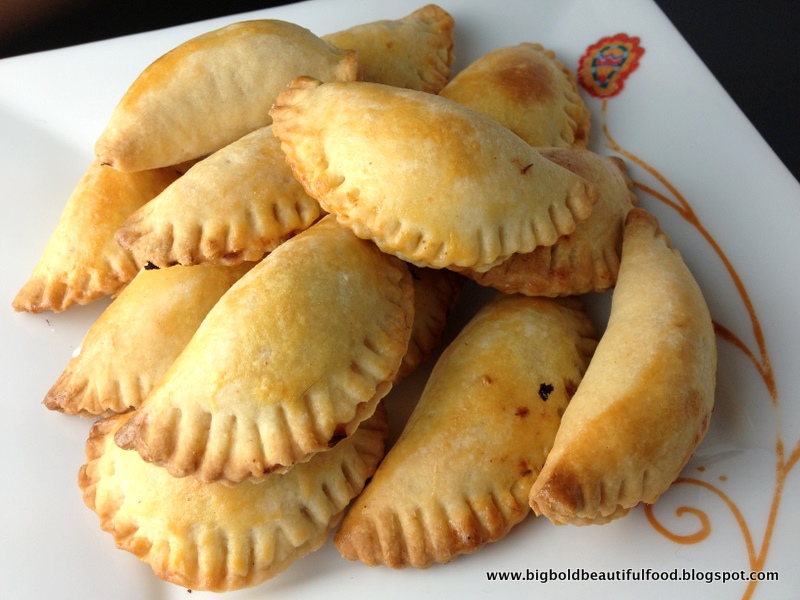
“An empanada is a stuffed bread or pastry baked or fried in many countries in Latin America,Southern Europe, and parts of Southeast Asia.” – Wikipedia

Here in Montevideo all the empanadas we have run across have been baked instead of fried. Across the river in Buenos Aires they have baked empanadas that they call “salteñas”. Empanadas are available at a variety of venues in Montevideo. At the supermarket they can be found near the bakery items. Empanadas can commonly be found at rotiserías that also sell fresh pasta and torts, and occupy little hole-in-the-wall stores that are hardly big enough to display their food. Empanadas can also be found at empanada specific restaurants or delivery centers.

At supermarkets and the small rotiserias the fillings are fairly limited and usually include carne (beef), pollo (chicken), acetuna (olives), jamón y queso (ham and cheese), and espinaca (spinach). At empanada restaurants and delivery centers there is much more variety, including dessert empanadas. El Taberna del Diablo (a restaurant and delivery center near our house) has 46 different kinds of empanadas.

One of the confusing things about buying empanadas, especially if you get different varieties, is coming home to a collection of stuffed pastries that all look alike. On closer inspection, each type of filling is shown on the outside using a unique marking. Small rotiserías will sometimes use pieces of dough to make shapes on the tops that correspond to their filling. Large delivery centers will use a combination of small holes punched in the edges and folded corners to distinguish the fillings. Though, without a guide map to the markings, the only thing to do is take a bite. Things could be worse!

Empanadas are so prevalent in the culinary sphere of Montevideo that most supermarkets carry pre-made empanada dough disks. All one needs to do is buy them, stuff them, and bake them to have a delicious snack or entire meal.

So, that’s exactly what we did! I made two types of empanadas, beef and apple. Below are the recipes that I created:

Beef Empanadas (recipe makes about 30 empanadas)

Ingredients:

3 tbsp olive oil

1 med onion chopped fine

1 large green bell pepper chopped fine

1 tbsp garlic chopped fine

2 peppers chopped (don’t know what kind, they call them “picante” here but jalapeños would work great)

1 tomato chopped

1.5 lbs ground beef

1 tbsp oregano

1 tbsp red pepper flakes

1 tsp cayenne pepper

1 tsp black ground pepper

0.5 tsp salt

Directions:

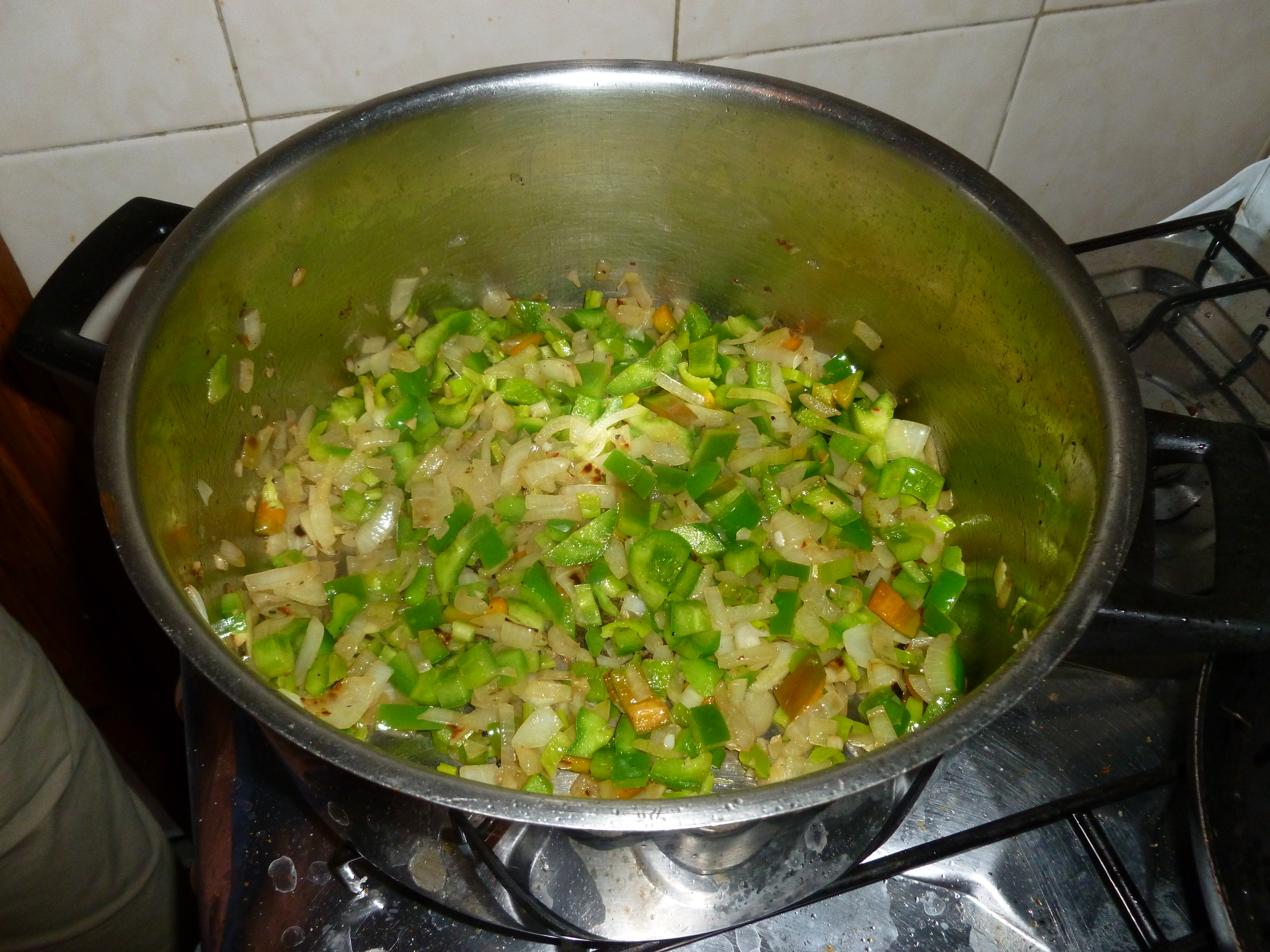
1. Saute onions, garlic, bell pepper and hot pepper in olive oil until just browned and soft.

2. Add meat, tomatoes and seasonings. Cook until meat is browned and broken into very small pieces.

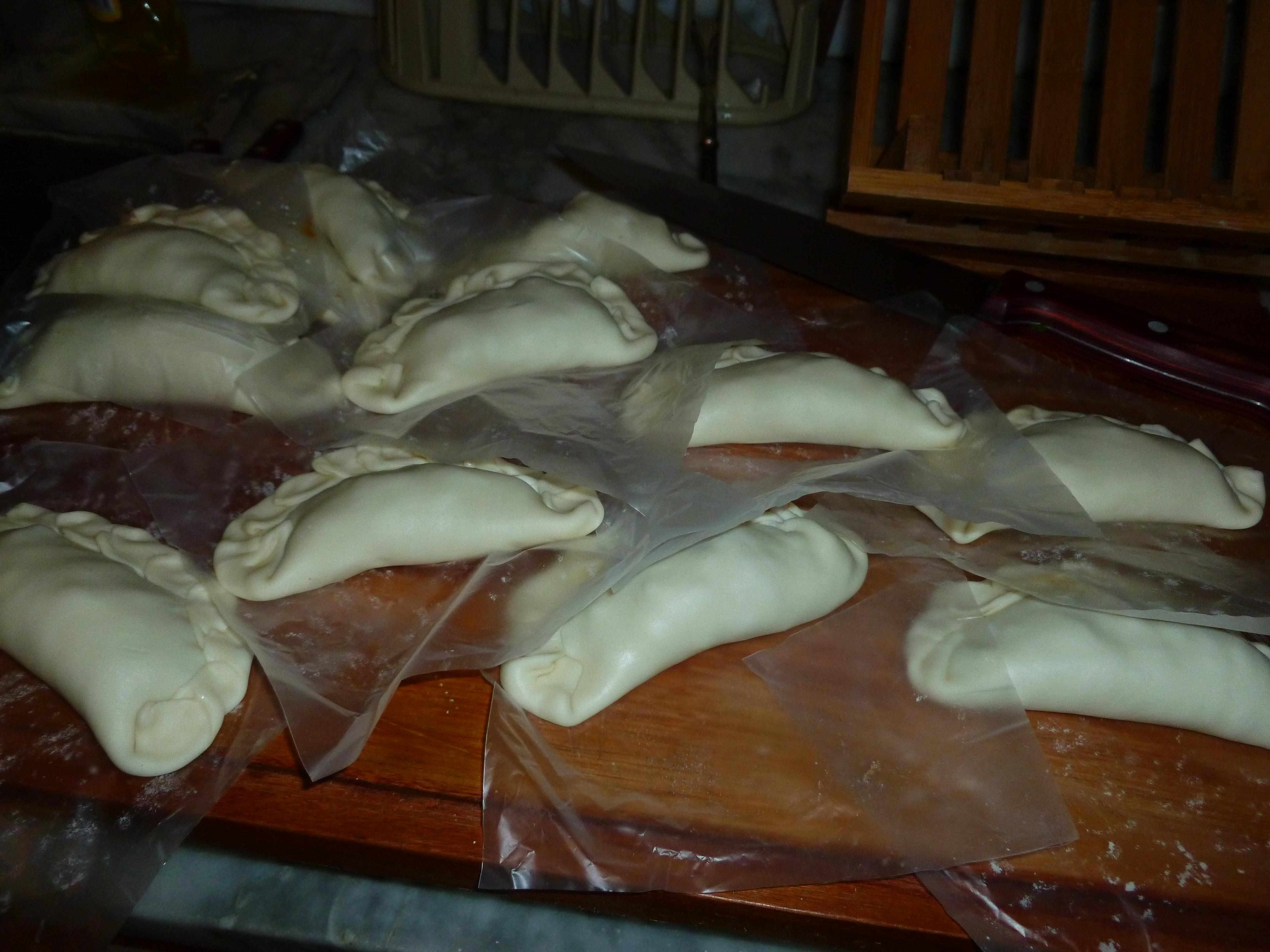
3. Cool mixture in the fridge for 1 hour, then add one spoonful to the center of a dough disk. Wet the edges of the disk with your finger and then fold over and seal. There are lots of different ways to seal empanadas including with a fork or with a braid. This video shows how to do it using the different techniques.

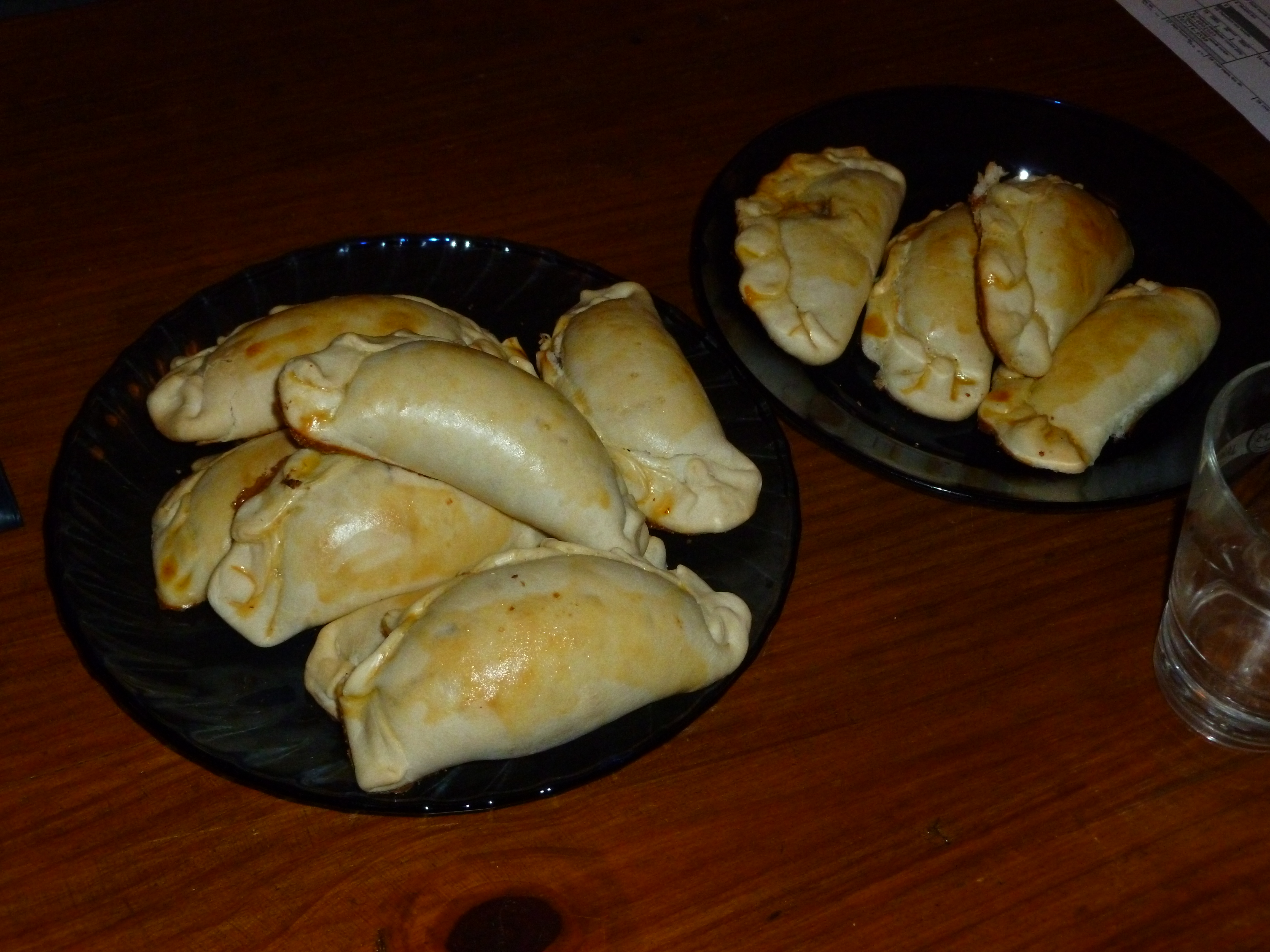
4. Brush the tops with egg yolk to help brown them in the oven. Since the oven here is a bit funky… I’ll just suggest that at home you bake the empanadas at 350 F for about 15 min.


Apple Empanadas (recipe makes about 15 empanadas):

3 large granny smith apples chopped

2 tbsp margarine

0.5 cups sugar

0.25 cups dulce de leche (like caramel)

1 tbsp flour

Directions:

1. Place the apples, margarine, and sugar in a pan and sauté over low heat. When the apples are soft, add the flour to thicken the mixture. Off heat add the dulce de leche and mix.

2. Place in the fridge for an hour and then fill the empanada disks with goodness! Use the same cooking instructions as above. Enjoy!


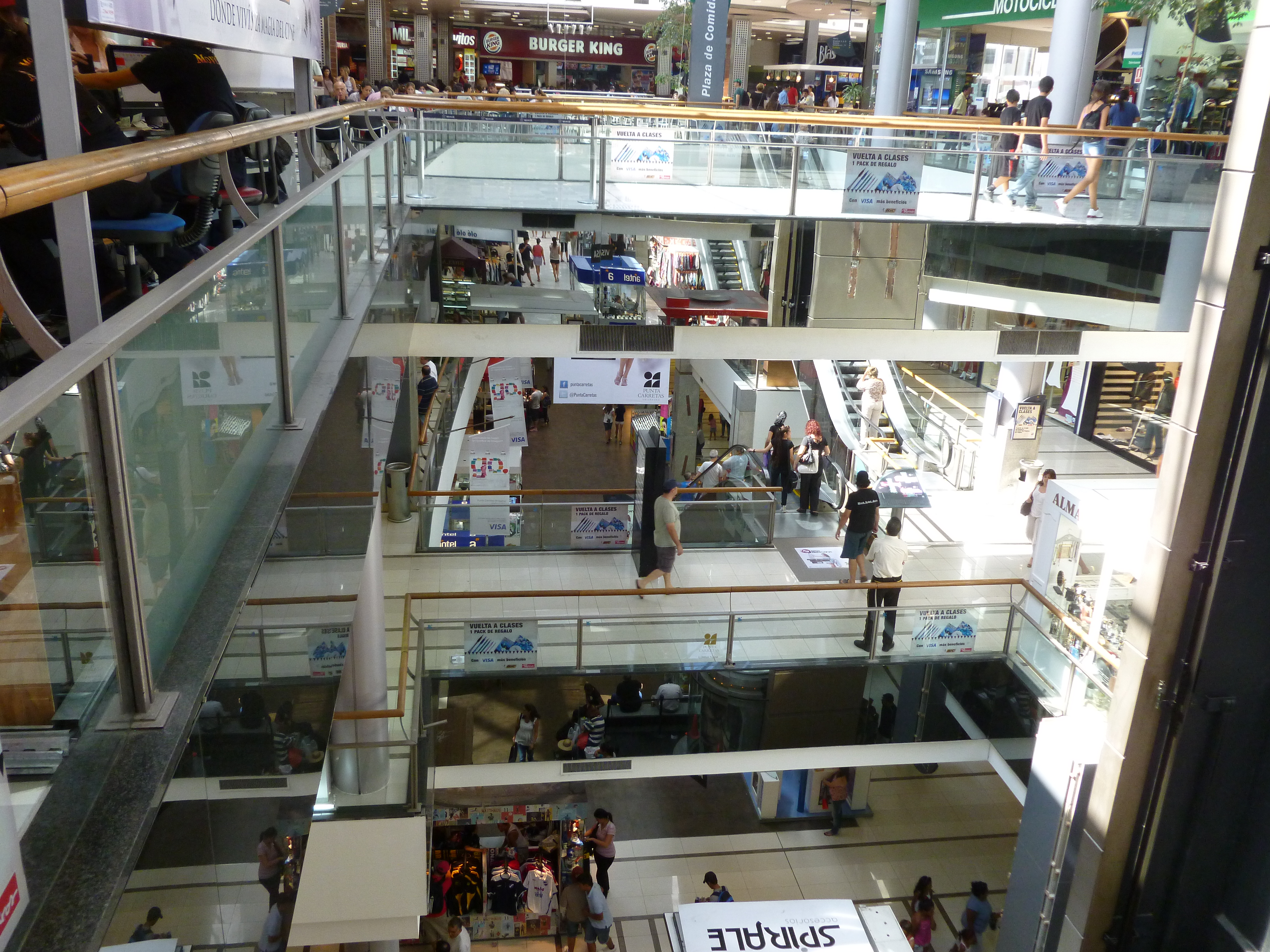
The Mall at Punta Carretas

We have now been to this mall twice. Once to try and find phones and this time to try and find fresh herbs. It is approximately a two mile walk from our house. The supermarket near our house has some fresh herbs, but doesn’t have cilantro, parsley or dill. We wanted to get some cilantro to include in our next project, making empanadas!

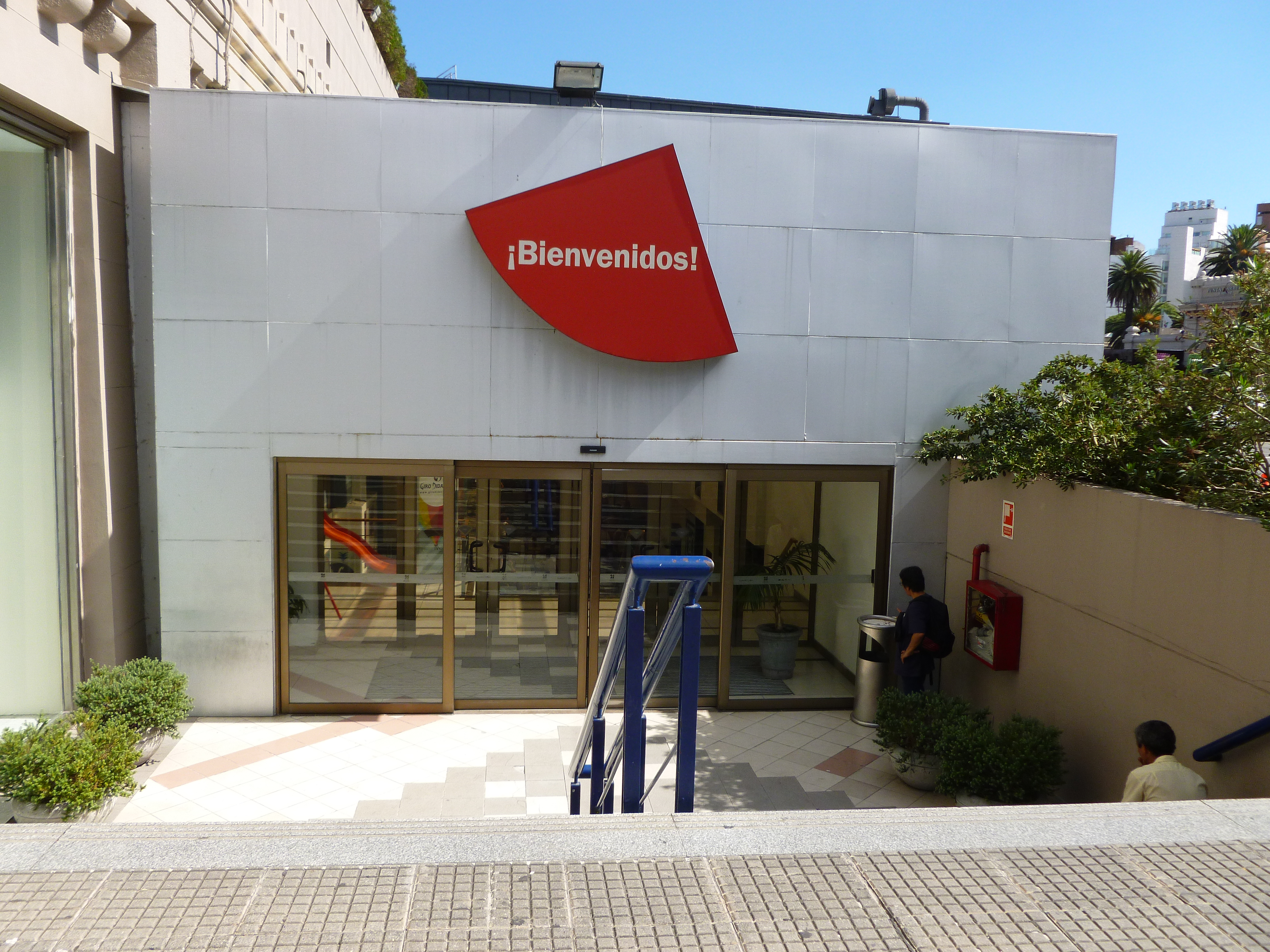
Entrance to the Punta Carettas mall.

The mall is very similar to malls in the U.S. There are lots of stores, lots of little places to eat. They have a food court that includes the token chinese food, mexican food, McDonalds and Burger King. We couldn’t really understand why the lines were so long at the McDonalds and Burger King when people could get fresh made chivitos, pasta, or pizza for the same price or cheaper. I bet it has something to do with the super-size coke. Most other places include drinks that are small (i.e. less than a can of soda), whereas McDonalds has the same 20 oz beverage as their small size. We enjoyed the chivitos and fresh pasta!

The mall is huge. It has three separate floors and skylights in the ceiling. There seem to be a lot of people wandering the mall on the weekends, possibly taking advantage of the air conditioning. In the summer this can be a big deal, as most people and other small stores don’t have air conditioning.

Inside the Punta Carettas mall looking down from the third floor.

The mall has a movie theater. Matinee price is about $6US and regular price is about $8. It looked like all the movies were in spanish so that might be a good adventure for the future.

There are many lots of little stands selling a variety of goods including: phones, hair bands, scarves, mate paraphernalia, jewelry, and trinkets. Most of the stores are fairly small and packed with merchandise. Many things are expensive. For example, a large paperback book can cost more than $20US. Again, the more expensive things are those that are imported.

There is a very large supermarket in the mall which has a wonderful produce section where we found our cilantro and dill. In most independent stores, including the supermarket at the mall, people are required to deposit their bags into a locker before going into the store. Stores have lockers with keys set up at the entrances just for this purpose. People are allowed to take purses with them into the store, but not backpacks or shopping bags. A security guard usually observes. I guess this is one of the measures put into place to deter petty theft.

When in Uruguay, Drink Maté

When in Rome, do as the Romans do.

When in Uruguay, do as the Uruguayans do… drink maté.

Maté is everywhere. It is similar to green tea. The taste is different, and takes a little getting used to, but it’s the same concept. Hot water with some amount of leaves or ground up foliage and a way to drink it without eating the foliage.

I’m a huge fan of green tea and maté is a readily available drink close to green tea in Uruguay.

I didn’t want to drink maté out of a regular glass or cup. I wanted to drink it like Uruguayans do. To do that, it requires the correct items and not one of the collectors glasses that we have from a whisky box set.

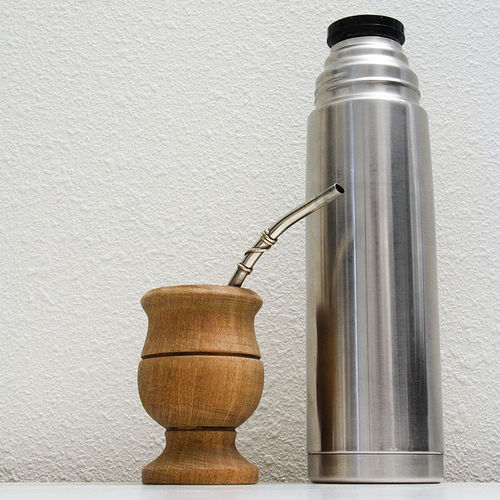
The different parts of a complete maté setup are:

Yerba maté, the tea

Maté gourd with yerba maté in it

Maté gourd (called maté)

Maté gourd and bombilla

Bombilla, the metal straw that looks like a spoon on one end with holes in it to act as a filter of the maté.

My shiny new bombilla

Thermos, to carry the hot water around since immediate access to hot water is very important.

Maté thermos

A maté gourd and thermos for all day yerba maté satisfaction

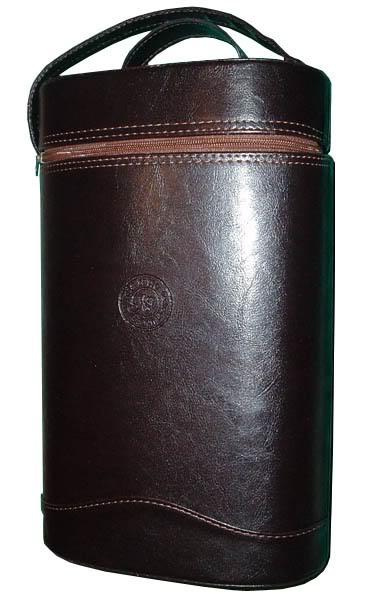
Matera, a leather satchel to carry everything around in.

Matera is used to carry a thermos, maté gourd, and yerba mate

Some people carry a matera around with them, but most people tuck their thermos under an arm and carry their gourd in the same hand of the arm with a thermos, leaving one hand free to do tasks.

Whenever we are outside, at least 1/4th of the people we see have a thermos tucked under one arm, while using the hand of that same arm to hold their maté gourd, full of yerba maté, hot water, and a bombilla.


And now, some maté information!

Appropriate times to drink maté: all day. Seriously, there is never a bad time to drink maté. You’re not cool if you’re not carrying around a thermos and maté.

Appropriate places to drink maté at: Everywhere!

I saw a guy struggling with 5 full grocery bags on one arm leaving a store, thermos and maté occupying the other while trying to take a sip without spilling or dropping anything.There is no way this guy would ever commit a party foul and spill a beer in hand, even if he fell down a flight of stairs. Hopefully he doesn’t fall down a flight of stairs though.

The most common places I see people with maté are:

  • The beach, even if it’s 100 degrees out, people are enjoying their super hot maté.
  • The bus, if you sit next to someone with maté on the bus and strike up a conversation, you might just get some maté.
  • La Rambla, the numbers increase of people drinkin maté at the La Rambla (street and large sidewalk next to the ocean/river). Seriously, it often gets close to 1 out of every 2 people have maté in hand around 7-8pm. The ones without maté are running or young children.
  • Walking on the streets, it seems important to never lose an opportunity to drink maté.

In case you are out and run out of hot water, you can refill your thermos with the correct temperature water at many gas stations, restaurants, bars, and more.

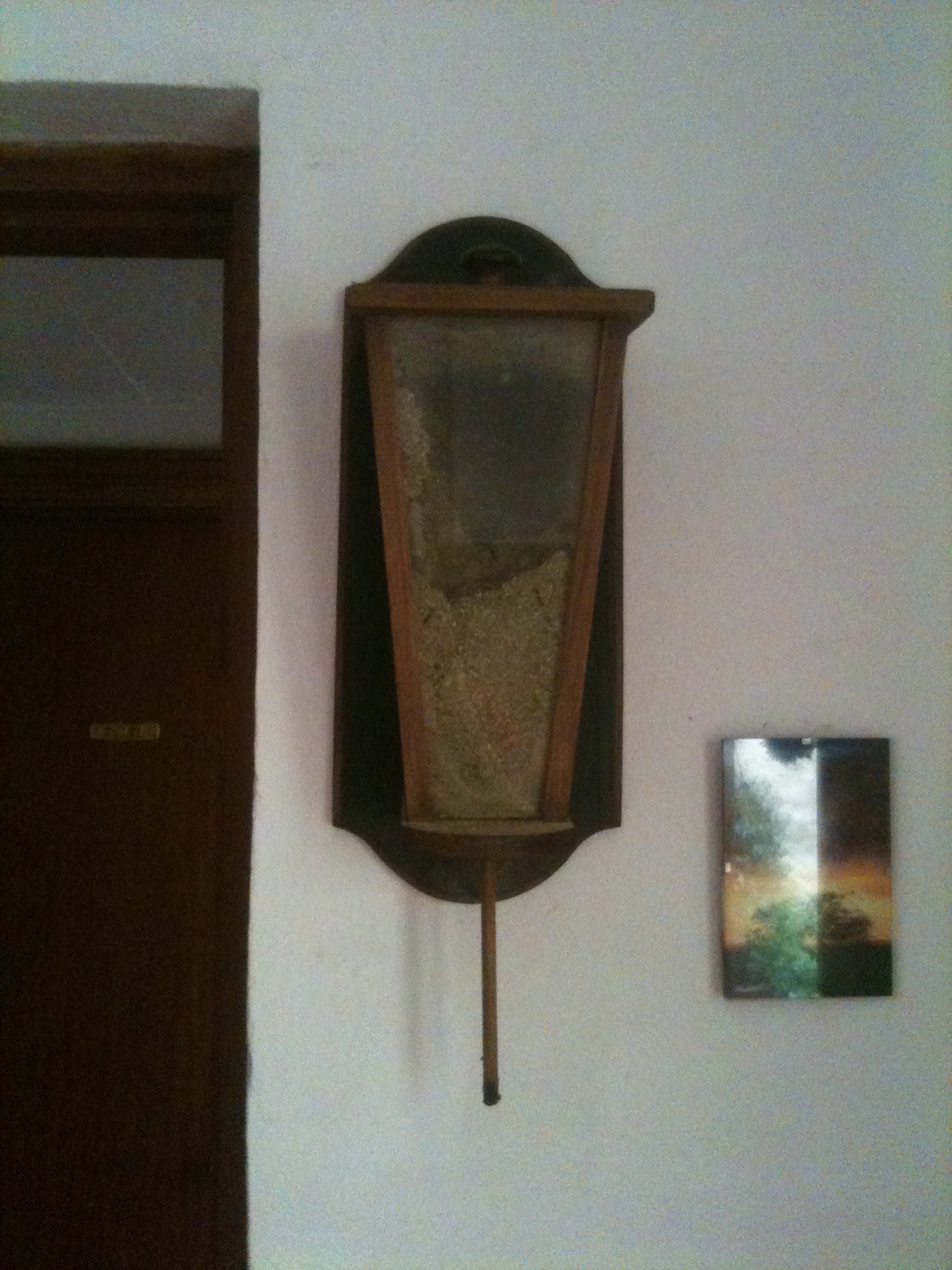
We have a maté dispenser on the kitchen wall in our house.

Push the gourd into the pole at the bottom and maté falls into the cup.

With all this maté going around, I’ve wanted to buy a maté gourd, bombilla, and thermos since I’ve been down here.

When in Uruguay, do as the Uruguayans do and drink maté!

This past Sunday, we went to the local market at Parque Rodo and I saw some maté gourds that I liked. After walking around to see what the market was about, I stopped and started talking to a very nice lady that was selling maté gourds and bombillas. She didn’t speak english except for a few words such as horse, english, and United States, and I felt pretty comfortable understanding and talking with her about the maté gourds.

Matt buying Maté

Buying a maté gourd and bombilla at the Parque Rodó market

About 10 minutes later, I walked away with my very own maté gourd and bombilla at a good price.

There were different sizes, different designs, and even gourds that were ceramic on the inside, but I chose to buy the traditional maté gourd with a logo of Uruguay on it. I’m sure only tourists have Uruguay on their maté gourd, but I liked it and figured people can pick out that I’m a tourist pretty quickly.

Preparing the Gourd

I was told that I needed to put cold water and maté in the gourd for 2 days to let it soak in and then lightly scrape the inside to remove the loose part of the gourd. This is supposed to take the bitterness out of the gourd. Everywhere online said to use hot water so I followed her directions and then the hot water directions.

So, here is my maté gourd and bombilla. I’ll buy a thermos and take my maté on adventures when I am more conversational in spanish. For now, I’m content with just drinking maté in our house.

Matt's maté gourd and bombilla


Featured image credits here.